Alexander Graham Bell (1847-1922) applies for a patent on his telephone apparatus, three hours before Elisha Gray files a caveat at the Patent Office for his as yet unperfected device.
February 18
Direct telegraph link is established between Britain and New Zealand.
March 7
Bell telephone system is patented in the US.
March 10
First practical use of a voice telephone system by Alexander Graham Bell at 5 Exeter Place, Boston, Massachusetts, USA. Bell says to his assistant: 'Mr Watson, come here. I want you.'
June 25
First public demonstration of Bell’s speaking telephone is given at Centennial Exhibition, Philadelphia, USA.
1877
April 18
Charles Cros writes a paper for the Académie des Sciences in Paris (deposited there on 30 April but not opened until 5 December) about his idea for a process which 'consists in obtaining traces of the movements to and fro of a vibrating membrane and in using this tracing to reproduce the same vibrations, with their intrinsic relations of duration and intensity, either by means of the same membrane or some other one equally adapted to produce the sounds which result from this series of movements', using a disc as the recording medium. Cros could not secure funds to make and patent the idea.
Thomas Edison first uses rhe word 'phonograph' on a drawing.
October 10
Article describing Charles Cros’s invention (see April 18) in La Semaine du Clergé by Abbé Lenoir uses the word 'phonograph' to describe it.
November 29
Thomas Edison makes drawings of his idea for a cylinder phonograph, which he gives to John Kruesi to execute.
December 1
Construction begins of a working prototype phonograph from Edison's drawings.
December 6
Edison records 'Mary had a little lamb' onto a cylinder wrapped with tin foil on his newly completed prototype hand-cranked phonograph at Menlo Park, NJ—the earliest recording of a human voice.
Eadweard Muybridge succeeds in taking a sequence of 12 photographs of a horse in motion, which triggers shutters by means of trip-wires as it passes; photographs incidentally produce serial analysis of motion. The apparatus is later doubled and re-doubled to take 24 and then 48 images.
Edison Speaking Phonograph Company is incorporated in the USA.
April
Photographic plates coated with gelatine emulsion are offered for sale in England by the Liverpool Dry-plate Company and by Wratten & Wainwright.
May 1-November 10
Among highlights of the Universal Exposition that opens in Paris today are Alexander Graham Bell's telephone, Edison's phonograph and electric lighting (installed along the Avenue and Place de l'Opéra) and the completed head of the Statue of Liberty. One of the international meetings staged during the Exposition is a Congress for the Protection of Literary Property, presided over by Victor Hugo, which leads to the formulation of an international copyright convention, and another that leads to the adoption of Braille. In due course Edison wins the Exposition's Grand Prix.
May 13
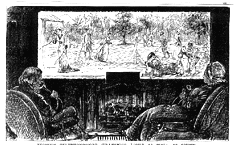
Thomas Edison receives a letter from Uriah Painter (his agent for the phonograph) in Washington DC reading: 'Hurrah for the telephonoscope. I'll get patent on it for you promptly as the others.' However, unlike Du Maurier's visionary cartoon, it appears to be an improved ear trumpet in which a paper funnel around a wire spiral—like the rifling in a gun barrel—captures the sound, which is carried to the ear through a rubber tube.
•
Letter to the British science journal Nature from London barrister Wordsworth Donnisthorpe (1847-1914) proposes a mechanism that would link the phonograph with moving picture images.
Cartoon by George du Maurier in Punch’s Almanac for 1879 captioned ‘Edison’s Telephonoscope (transmits light as well as sound)’ shows a wide-screen videophone conversion between London and Ceylon. It is barely a year since Edison's first major invention and much more advanced than Edison's own idea for a 'telephonoscope'.
Click on picture to enlarge
•
Edison commissions 600 tin-foil phonographs from several workshops to circulate for demonstration purposes. He experiments with disc recording but rejects it. He then apparently loses interest in sound recording until competition emerges almost a decade later.
•
Carbon filament incandescent lamp invented in UK by J W Swan with collaboration of C H Stearn (high vacua production expert), F Topham (glass-blower) and C F Cross (who discovered the viscose process for the nitro-cellulose filament fibres).
•
Arthur-Louis Ducos Du Hauron publishes Photographie en Couleur, in which he develops practical proposals for the subtractive approach to colour photography that he first outlined in 1869.
•
Thomas Henry Blair devises a portable integrated photographic system called the Tourograph. In one box it includes a camera, wet collodion plates (subsequently changed to dry gelatin) and the necessary chemistry for processing.








 Chronomedia index
 William Preece quotation