New York Daily Graphic prints the first half-tone photographic image in a newspaper.
April 26
Alexander Graham Bell and Charles Sumner Tainter demonstrate the photophone, a device in which a mirrored silver disc is made to vibrate by speech from a speaking tube. Light reflected off the disc is captured in a parabolic dish and focused onto a selenium cell, where variations in the reflected light are converted into the electrical signals that are carried to headphones. The laser disc and CD of the 1970s work on a remarkably similar principle.
June 1
Connecticut Telephone Company installs public telephone booths on its premises in New Haven, the first available for public use in the USA.
October 1
Edison Lamp Works in New Jersey produces its first commercial electric light bulbs.
•
George Eastman and Henry Strong start manufacturing photographic dry plates, using Eastman's machine, in a rented third-floor space in Rochester, NY .
•
Maurice Leblanc proposes horizontal and vertical scanning by vibrating mirrors for electrical transmission of images.
•
Method of mechanical scanning of images is outlined by George Carey of Boston, US in Design and Work.
•
Theoretical studies of the principles of television are published by Adriano de Paiva.
•
Principle of piezo-electric effect—the relationship between voltage generated and mechanical pressure of crystallographic materials—is developed by Jacques and Pierre Curie.
•
With the $10,000 Volta Prize awarded by the French government in recognition of the invention of the telephone, Alexander Graham Bell establishes a laboratory in Washington DC (the Volta Laboratory) to study acoustics and sound reproduction in collaboration with his cousin, chemical engineer Chichester A Bell, and scientist and instrument maker Charles Sumner Tainter.
Charles Tainter develops the lateral-cut technique for cylinder recording. The cutting stylus moves from side to side and is thus not as destructive of the cylinder's recording surface as Edison's vertical movement (hill-and-dale).
•
George Eastman and Henry Strong form the Eastman Dry Plate Company.
•
Thomas Henry Blair forms the Blair Tourograph & Dry Plate Company to take over marketing of his Tourograph complete photographic kit.
•
Shelford Bidwell in the US demonstrates equipment for transmitting silhouettes.
The device is preserved in the Science Museum, London.
•
At the Paris Electrical Exhibition, Clément Ader ranges 80 telephone transmitters across the front of a stage to create a form of (binaural) stereophonic sound. Musical performances are relayed from the Opéra and the Comédie Française.
Eadweard Muybridge further improves his Zoögyroscope as the Zoöpraxiscope.
•
Louis Lumière (1864-1948) introduces his Blue Label photographic plate, with much improved photosensitivity allowing shorter exposure times.
•
Public telephone service is launched in the Buenos Aires area of Argentina by Compañia Telefónica del Plata.
•
Richard D’Oyly Carte builds the Savoy Theatre in London to stage the Gilbert & Sullivan comic operas—the ‘Savoy Operas’.
1882
February
Jules-Etienne Marey (1830-1904) invents a photographic gun, taking 12 images a second on a single plate.
July
Marey’s chronophotographs are shown.
•
Speed of light is measured at 186,282 miles per second, 299,778 km/sec.
•
Théodore Puskás, a Hungarian who has previously worked in Edison's laboratories in Menlo Park, demonstrates a ‘telephoned newspaper’ at Paris Electrical Exhibition and subsequently establishes a system in Budapest.
Sir William Crookes anticipates the possibilities of wireless telegraphy, including tunable receivers, in an article in The Fortnightly Review (51:302).
1883
•
Frenchman Albert Londe (1858-1917) records images at the Hôpital de la Salpêtrière in Paris using a multiple-lens camera.
1884
January 6
German patent no 30105 for an ‘electric telescope’ is granted to Paul Gottlieb Nipkow (1860-1940) [right], the 30 marks fee being lent by his future wife. This is a ‘television’ system comprising a scanning disc and selenium cell.
General Post Office opens the first telephone call offices in England for use by the public.
October 10
First edition of weekly UK journal The Amateur Photographer. It consists of 16 pages and includes one illustration, an engraving of 'Marion's Miniature Camera'. It does not include any photographs.
Picture source: Terra Media Archives, Amateur Photographer
•
Estimated 40 tons of silver and three tons of gold are used annually in the UK photographic industry.
•
Emile Berliner makes a cylinder recording of the Lord’s Prayer—the oldest record in BBC Record Library.
•
The first long-distance telephone cable in the US is installed between New York and Boston.








 Chronomedia index
 German patent no 30105 for an ‘electric telescope’ is granted to Paul Gottlieb Nipkow (1860-1940) [right], the 30 marks fee being lent by his future wife. This is a ‘television’ system comprising a scanning disc and selenium cell.
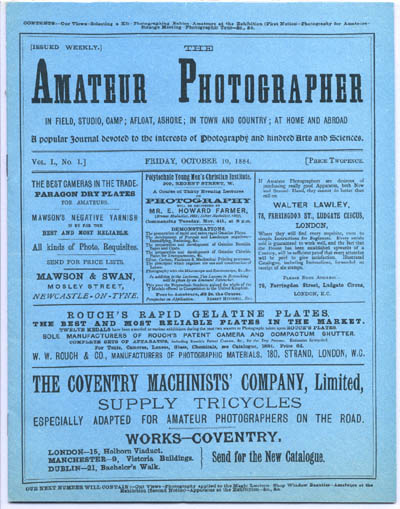 First edition of weekly UK journal The Amateur Photographer. It consists of 16 pages and includes one illustration, an engraving of 'Marion's Miniature Camera'. It does not include any photographs.