| 1895 |
 Chronomedia index Chronomedia index
Numbers after entries link to the list of references. |
links and notes |
| |
Predictions made this year |
|
| January 3 |
Cecil Wray, an engineer of 2 Southbrook Terrace, Bradford, Yorkshire patents a device that allows Kinetoscope pictures to be projected onto a screen. [0024] |
> 1896 June 11 |
| February 13 |
Lumière's Cinématographe is patented in France. |
|
| February |
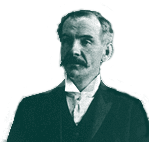 Birt Acres [right] and R W Paul start work on a cine camera using film stock from the European Blair Camera Company. Birt Acres [right] and R W Paul start work on a cine camera using film stock from the European Blair Camera Company. |
> August |
| February |
Jean Acmé Leroy, formerly a collaborator of Le Prince, presents a showing of his 'Marvelous Cinematograph' to a paying audience at Clinton, New Jersey. |
|
| March 22 |
Auguste and Louis Lumière demonstrate their film system to the Société d’Encouragement à l’Industrie Nationale at 44 rue de Rennes, Paris, screening their film La Sortie des Ouvriers de l’Usine Lumière. |
|
| spring |
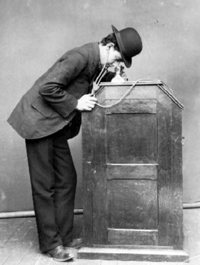 Edison begins marketing Kinetophones that use mechanical linkage between his phonograph and kinetoscope to produce sound pictures, still in a peepshow presentation. There is no true synchronisation. The viewer listens to the sound through two rubber tubes. Edison begins marketing Kinetophones that use mechanical linkage between his phonograph and kinetoscope to produce sound pictures, still in a peepshow presentation. There is no true synchronisation. The viewer listens to the sound through two rubber tubes. |
|
| April 2 |
W K L Dickson leaves the Edison Company. He has been advising Woodville Latham about film matters, including image projection. |
> December 21 |
| • |
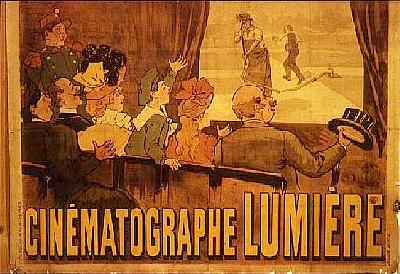 Louis Lumière makes the first French dramatic/comedy film, L’Arroseur arrosé (The waterer watered), using his gardener, M Clerc, and his apprentice, a boy called Duval, as the performers. A scene from the film was used in the generic poster for Cinématographe Lumière performances [right]. Louis Lumière makes the first French dramatic/comedy film, L’Arroseur arrosé (The waterer watered), using his gardener, M Clerc, and his apprentice, a boy called Duval, as the performers. A scene from the film was used in the generic poster for Cinématographe Lumière performances [right]. |
|
| May 20 |
First specifically incorporated film company, Lamda Company, shows a four-minute boxing film to a paying audience using its wide-film Eidoloscope projector, invented by Eugène Lauste at 153 Broadway, New York. According to W K L Dickson, the film path includes a loop to reduce stress on the film. |
|
| August |
Birt Acres gives public demonstrations, using his own film equipment, at Barnet, Hertfordshire. |
|
| September |
C. Francis Jenkins and Thomas Armat demonstrate their Phantascope film projector at the Cotton States Exposition in Atlanta, Georgia. |
|
| • |
 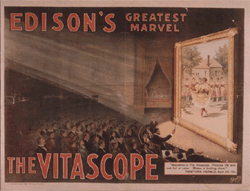 After Jenkins and Armat dissolve their partnership, Armat sells the rights in the Phantascope to the Kinetoscope Company. Edison insists that the device should be called the Edison Vitascope. After Jenkins and Armat dissolve their partnership, Armat sells the rights in the Phantascope to the Kinetoscope Company. Edison insists that the device should be called the Edison Vitascope.
[right; source: Smithsonian Institution]. |
|
| October 24 |
Robert W Paul applies for a patent (no 19984) for 'A novel form of exhibition or entertainment, means for presenting the same', this being a simulated time travel ride. Spectators on a platform that can be rocked to suggest movement are surrounded by moving pictures, slides and lighting effects. |
|
| November 1 |
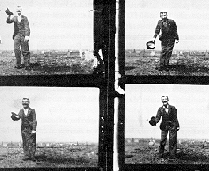 Brothers Max and Emil Skladanowsky begin a series of public demonstrations to paying audiences of their Bioskop films [left]. Images are recorded on two loops of 54mm film, frames being projected onto a screen from each loop alternately to produce a frame rate of 16 fps. The shows at the Wintergarten music hall in Berlin continue for about four weeks. Brothers Max and Emil Skladanowsky begin a series of public demonstrations to paying audiences of their Bioskop films [left]. Images are recorded on two loops of 54mm film, frames being projected onto a screen from each loop alternately to produce a frame rate of 16 fps. The shows at the Wintergarten music hall in Berlin continue for about four weeks. |
|
| November 8 |
X-rays are discovered by Wilhelm Röntgen. |
|
| December 18 |
Birt Acres' assistant, Arthur Melbourne-Cooper, gives a film screening at South Mimms, Hertfordshire. |
|
| December 21 |
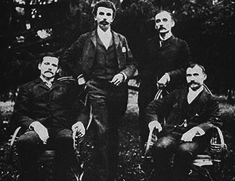 American Mutoscope Company is formed by W K L Dickson—second from left in the photo with his co-founders, Herman Casler, Elias Koopman and Henry Norton Marvin. American Mutoscope Company is formed by W K L Dickson—second from left in the photo with his co-founders, Herman Casler, Elias Koopman and Henry Norton Marvin. |
> 1899 |
| December 28 |
Lumière Brothers (and father) give a public demonstration of their films in the Salon Indien at the Grand Café, 14 Boulevard des Capucines, Paris. An audience of 33 people, including Georges Méliès, pay one franc each for admission. The Lumières refuse offers to buy copies of their equipment. |
 |