| 1896 |
 Chronomedia index Chronomedia index
Numbers after entries link to the list of references. |
links and notes |
| January 1 |
Wilhelm Röntgen announces his discovery of X-rays. |
|
| January 12 |
X-ray photograph of a hand with a bullet in it is taken by Dr Henry L Smith of Davidson, North Carolina, allegedly the first ever X-ray photo. |
|
| January 14 |
Demonstration of equipment and presentation of a programme of films are given by Birt Acres using his 'kinetic lantern' at Royal Photographic Society, 14 Hanover Square, London—the first UK public film screening. |
|
| January 25 |
Private preview of the Lumière Cinématographe is given at the Empire Theatre, Lyons, France, prior to the start of public exhibitions the following day. |
|
| February 20 |
Robert W Paul screens Rough Sea at Dover and other of his films to an invited audience at Finsbury Technical College, London. |
> March
 This film can be viewed by educational users and researchers at screenonline This film can be viewed by educational users and researchers at screenonline |
| February 20 |
Screening of the Lumière Cinématographe is held for the press at the Marlborough Hall of the Regent Street Polytechnic, London. |
|
| February 21 |
First UK commercial film screenings of the Lumière Cinématographe begin at the Regent Street Polytechnic, London. The shows are managed by French magician Félicien Trewey and run for a three-week period at 14:00-16:00 daily. The admission charge is 1s (5p). Among those who see the films is the Hove optical lanternist and showman George Albert Smith. |
|
| February 28 |
R W Paul demonstrates his Theatrograph at the Royal Institution in Albermarle Street, London. |
> 19 March |
| February 28 |
Private screening of the Lumière Cinématographe is given at the Empire Theatre of Varieties in Leicester Square, London. |
> 7 March |
| February-August |
Lumière films are shown for the first time to paying audiences in various countries throughout Europe and elsewhere by showmen who have bought Cinématographe projectors, rapidly expanding awareness of the new medium.
• February at Ospedale i Carita in Turin, Italy by Vittorio Calcina.
• March 1 at 7 Galerie du Roi, Brussels, Belgium.
• March 13 at Le Lieure photographic gallery in Rome.
• March 19 at Graphic Arts Teaching and Research Centre in Vienna, Austria by E J Dupont.
• May 4 at Aquarium Theatre, St Petersburg—the first commercial Russian film show. (or May 16?)
• May 10 at Royal Hotel, Budapest; includes scenes photographed in nearby streets, including a military procession.
• May 15 at 34 Carrera de San Jeronimo, Madrid, Spain by M Promio.
• May 27 at Salon l'Independenta Romana in Bucharest, Romania.
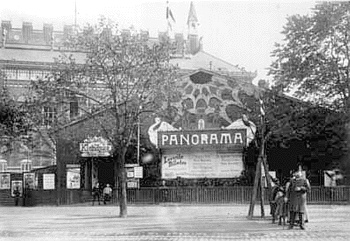 • June 7 in a wooden pavilion called the Panorama (aka Panopticon), constructed in Rådhuspladsen, Copenhagen, Denmark [right]. Presented by Vilhelm Pacht, a painter, shows continue until the building is burnt down in an arson attack on June 30. The royal family visit on June 11.
• June 7 at Kod Zlatnog Krsta Café, Belgrade, Serbia.
• June 9 at Kurhaus, Scheveningen, Netherlands.
• June 28 at Societetshuset, Helsinki, Finland. Despite high admission charges, shows continue for eight days.
• June 28 at the Industrial Exhibition in the Malmö Summer Palace, Sweden by by Harald Limkilde, a Danish showman. A total of 30,000 people see the shows in the following days.
• July 7 at Watson's Hotel, Bombay, India, moving a week later to the Novelty Theatre nearby.
•July 15 at Lázenský dom, Karoly Vary, Czechoslovakia.
• July 18 at El Salón Rouge, 25 de Mayo 285 (now 418), Montevideo, Uruguay. The admission charge is 40 centésimos. In October a show is included in a programme of zarzuela at the Teatro San Felipe in Montevideo and in the following month at 18 de Julio 130 for three hours a night (20:00-23:00).
• July 28 at Colón Theatre, Buenos Aires, Argentina by Francisco Pastos and Eustaquio Pellier.
• August 15 at 17 Calle de Jesus, Mexico City by Salvador Toscano Barragan, an engineering student. |
For Sweden see also July 21 below |
| March 7 |
Screening of the Lumière Cinématographe is included in a matinee show at the Empire Theatre of Varieties, Leicester Square, London |
> 9 March |
| March 9 |
Regular screenings of the Lumière Cinématographe begin at the Empire Theatre of Varieties, Leicester Square, London |
|
| March 19 |
Screenings of R W Paul's Theatroscope begin at the Egyptian Hall in Piccadilly, London. |
> March 21 |
| March 21 |
Screenings of R W Paul's Animatographe films begin at Olympia, London. |
> March 25 |
| March 25 |
Following his Olympia screening, R W Paul is offered a two-week season at the Alhambra Theatre, Leicester Square and stays for four years. Many of his drama films are shot on the roof of the Alhambra. |
|
| March 25 |
The first UK cinematographe screening outside London is given at the Pandora Galley, King's Road, Brighton. |
 Brighton and film Brighton and film |
| • |
Edison acquires the patents to the Vitascope film projector mechanism designed by Thomas Armat and C Francis Jenkins, for which they lack the capital to develop commercially. |
> April 23 |
| early |
Louis Lumière and Victor Planchon begin to adapt Lumière's Etiquette bleue (Blue Label) emulsion for photographic plates for use on celluloid. The process to come to full production takes a year to achieve. |
|
| April 6 |
First commercial film screening in Norway and first in all Scandinavia is at Circus Variété in Christiania (later Oslo) by Max and Emil Skladanowsky using their Bioskop equipment. Shows continue until May 5 due to popular demand. |
|
| April 20 |
Star of Erin Variety Theatre in Dublin puts on the first commercial film screening in Ireland. |
|
| April 23 |
First motion picture projection screenings in New York City are given at Koster and Bial's music hall; the projectionist (using what is by now called the Edison Vitascope) is Edwin S Porter. As well as five films made by the Edison company, the programme includes R W Paul's English production Rough Sea at Dover. The films are made into 40-foot loops for repeated showing. |
Porter: see 1902 late |
| April |
R W Paul shoots the first dramatic film in the UK, The Soldier's Courtship, starring Robert Storey. |
|
| April |
Frenchman Auguste Blaise Baron (1855-1938) and Fréderic Bureau (d.1896) are granted a French patent for a sound synchronisation system, inspired by seeing an Edison Kinetophone. |
> 1900 |
| May 5 |
Birt Acres gives the first commercial film screening in Wales at Cardiff Town Hall. |
|
| May 9 |
R W Paul's Theatrograph film programme is shown at the Empire Theatre of Varieties, Johannesburg. |
|
| May 27 |
Acres and Paul show their first 'commercial' film production for the Kinetoscope, The Oxford and Cambridge University Boat Race (see 1895), at the India Exhibition, Earl's Court, London. |
|
| June 2 |
Guglielmo Marconi applies for the first ever patent on wireless telegraphy. |
|
| June 11 |
In Bradford, Yorkshire, Cecil Wray demonstrates his Kineoptoscope device (also called the Cinetograph), an adaptation of a standard magic lantern for projecting Edison Kinetoscope films onto a screen. Another Bradford firm, Riley Brothers, acquires the patent rights and begins marketing the device.
During the year Wray establishes a company with Cecil William Baxter at Borough Mills, Manchester Road, Bradford to manufacture and sell the B&W Cinematograph, which is claimed to be the first film camera used in Japan. The company also goes on to sell films. [0024] |
> November
Wray > 1897 May 6 |
| June 18 |
First Portuguese commercial film show given at Real Coliseu, Rua de Palma, Lisbon by Erwin Rousby. |
|
| June 29 |
Lumière Cinématographe is shown for the first time in the USA at Keith's Union Square Theatre in New York. |
|
| July 21 |
First film presentation in Stockholm, Sweden is given by Charles Marcel, correspondent of Le Soir at the Djurgårten Glace Palace using an Edison Kinetoscope. Max and Emil Skladanowsky soon take over the franchise and include their own films of Djurgårten—the first film shot in Sweden. |
|
| July 28 |
First Canadian commercial film show at West End Park, Ottawa using an Edison Vitascope projector. |
|
| July |
First Brazilian commercial film show uses Omniographo projector. |
|
| August 11 |
Programme of French (?) films is included in a variety show at Hsu Gardens, Shanghai, China. |
|
| August 22 |
Programme of R W Paul films is given at Melbourne Opera House, Australia by Carl Hertz, a conjuror, the first projected film show in Australia. |
|
| September 28 |
Pathé-Frères film company is founded in Paris by Charles and Emile Pathé. Charles Pathé has already established a successful business importing cylinder recordings from England and making original recordings, which sell from his shop at 72 cours de Vincennes. |
> 1897 |
| • |
Pathé film company in France experiments with synchronising films and gramophone discs to create sound films. |
|
| September |
Edison stops buying film stock from the American Blair company as Eastman takes over supplying all Edison's needs. Soon after Eastman acquires the American Blair company. |
|
| • |
European Blair Camera Company becomes the film stock supplier for most of the leading film-makers in the UK and France, including Birt Acres, the Lumières, Robert W Paul, George Albert Smith and Charles Urban's Warwick Trading Company. |
> 1909 |
| September 29 |
Amateur photographer A P Fedetsky films Cossack Trick Riders at Kharkov in the Ukraine. |
|
| October 12 |
Biograph projector, developed by W K L Dickson for the American Mutoscope Company, in which he is a partner, is used in public for the first time at Hammerstein's Opera House in New York. |
> 1897 January 18 |
| October 13 |
Programme of English films (probably by R W Paul) shown at Auckland Opera House, New Zealand by Professors Gow and Hausmann. |
|
| October 19 |
 Vitascope Hall cinema opens in the basement of the Ellacott Square Building on Main Street, Buffalo, NY. The architect-designed 72-seater is in the Edisonia Hall [right] and possibly occupies the space of a former Kinetoscope parlour. The site also includes a phonograph parlour with free admission. In his book A Thousand and One Nights (1925), pioneer movie historian Terry Ramsaye describes this as arguably one of the first permanent movie exhibitions in the world. Vitascope Hall cinema opens in the basement of the Ellacott Square Building on Main Street, Buffalo, NY. The architect-designed 72-seater is in the Edisonia Hall [right] and possibly occupies the space of a former Kinetoscope parlour. The site also includes a phonograph parlour with free admission. In his book A Thousand and One Nights (1925), pioneer movie historian Terry Ramsaye describes this as arguably one of the first permanent movie exhibitions in the world. |
|
| October 27 |
Passengers Alighting from Ferry ‘Brighton’ at Manly is screened at the Salon Lumière, 237 Pitt Street, Sydney. One of several subjects shot around Sydney Harbour during the previous month by Maurice Sestier, Lumières' Australian agent, and Walter Barnett, a portrait photographer. |
> November 3 |
| October 31 |
The Australian Jockey Club (AJC) Derby horse race is filmed at Melbourne. |
|
| October |
Programme of Edison films is shown at Lvov, Poland. |
|
| November 3 |
Maurice Sestier and Walter Barnett film the Melbourne Cup, the first famous film made in Australia. |
|
| November 15 |
The Phonoscope, a monthly journal devoted to scientific and amusement inventions appertaining to sound and sight is first published in New York by Russell Hunting. |
|
| November |
Edison introduces the Projectoscope (Projecting Kinetoscope) and abandons marketing the Vitascope. |
|
| November |
R J Appleton & Co, a photographic and magic lantern supplier of 58 Manningham Lane, Bradford, Yorkshire, introduces the Cieroscope, a film camera/printer/projector device that sells for 15 guineas (£15.75). A special lens, made by Cecil Wray, costs an extra two guineas (£2.10). |
Appleton > 1897 June 22 |
| December |
R W Paul offers a number of his 'cinematograph reproductions' (film prints) to the British Museum for preservation. |
|
| • |
Film production begins in
• Denmark: Kørsel med grønlandske Hunde (Running with Greenland dogs), made by Peter Elfedt;
• Hungary: Arnold Sziklay shoots footage of Emperor Franz Josef opening the Millenial Exhibition in Budapest;
• Italy: Italo Pacchioni replicates the Lumière favourite with Arrivo del treno stazione di Milano;
• Portugal: Aurelio de Paz dos Reis replicates another: Leaving the Factory;
• Spain: Eduardo Jimino films Salida de misa de doce en la Iglesia del Pilar en Zaragoza (Leaving the noon mass at the Church of St Pilar in Zaragoza). |
|
| • |
Brighton portrait photographer Esmé Collings makes more than 30 films during the year, including at least one, The Broken Melody, in which a professional actor, a Mr Van Biene, is employed. Collings had been a partner of William Friese-Greene. |
|
| • |
American film cameraman Woodville Latham applies for a patent on his idea of creating loops of film above and below the camera gate and continuously running sprocket wheels to feed the film, to remove the tension in the film that frequently causes the film to tear. R W Paul in Britain develops similar projection technology. |
> 1902 |
| • |
Lumière Cinématographe, Edison's Kinetoscope and Vitascope and Lubin's copy of the Vitascope are demonstrated in Japan. |
|
| • |
First Egyptian commercial film shows are given at Zavani Café in Alexandria. |
|
| • |
Gramophone with clockwork motor and friction governor speed control goes on the market. |
|
| • |
Parlophone record company is founded in Germany by the Carl Lindström Company. |
|
| • |
Prestwich Film Company in UK introduces a film system based on 60mm wide film stock. In the US, the Veriscope Company uses a 63mm film. |
|
| • |
Among films released by Max Skladanowsky is Eine Lustige Gesellschaft vor dem Tivoli in Kopenhagen (A Jolly Group in Front of Tivoli in Copenhagen), also released as Eine Kleine Szene aus dem Strassenleben in Stockholm (A Little Scene of Street Life in Stockholm). |
see also July 21 |
| • |
Stage musician Georges Méliès establishes the Star Film Company in Paris. He buys a film camera from R W Paul. |
|
| • |
Hand-colouring of film prints is first employed. |
|
| • |
Already nine French travelling fairs include booths showing films. |
> 1897 |
| • |
British publisher George Newnes launches the Penny Library of Famous Books with average weekly sales of 96,000 copies. |
|
| • |
The Daily Mail newspaper founded in UK by Alfred Harmsworth. |
|