| 1902 |
 Chronomedia index Chronomedia index
Numbers after entries link to the list of references. |
links and notes |
| |
Cultural highlights | Predictions made this year |
|
|
|
| January 17 |
Times Literary Supplement is first published. |
|
| March 18 |
Enrico Caruso records 10 arias in Milan for the Gramophone Company. The Italian tenor is paid a fee of $500 for the session. |
|
| March |
Biograph wins a temporary legal victory in its appeal against a lower court's decision in favour of Edison's cinematograph patents. Biograph claims to be the sole US agent for Georges Méliès' Star Films and Warwick Trading Company films—imported rather than home produced. |
> 1906 March |
| April 2 |
Electric Theatre, the first cinema in Los Angeles, opens. The admission charge is 10 cents for a one-hour programme. |
|
| • |
In its 1901/02 financial year, UK's Gramophone and Typewriter Company makes £137,268 net profit (equivalent to £8.72m in 2001). |
|
| June |
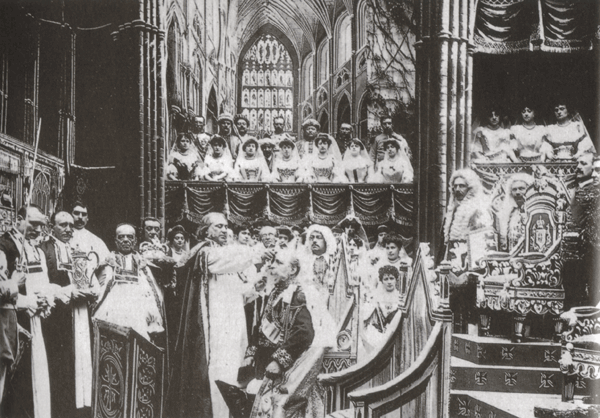 Charles Urban commissions a film of the coronation of Edward VII, which is scheduled for 26 June. The film is made by Georges Méliès at his Star Films studio at Montreuil, Paris, using actors. The coronation is delayed because of the king's illness until 9 August. Rights to film the actual event are held by the Mutoscope and Biograph Company. Charles Urban commissions a film of the coronation of Edward VII, which is scheduled for 26 June. The film is made by Georges Méliès at his Star Films studio at Montreuil, Paris, using actors. The coronation is delayed because of the king's illness until 9 August. Rights to film the actual event are held by the Mutoscope and Biograph Company. |
|
| August 26 |
US patent 707934 is awarded to Woodville Latham for his idea of including loops in the projector's film path to reduce tension. |
> 1908 February 9 |
| late |
Edwin S Porter directs The Life of an American Fireman, a pioneer narrative film, made in New Jersey for Edison Manufacturing Company. It is apparently copied shot for shot from James Williamson's British film Fire!, made the previous year. Porter's film is released in January 1903. |
|
| November 28 |
Marconi sends wireless signals across the Atlantic from a more powerful new transmitter at Glace Bay, Cape Breton Island, Nova Scotia, Canada to Poldhu in Cornwall. Reception is faint. (See also December 5). |
|
| December 5 |
Signals transmitted by Marconi from Cape Breton Island to Cornwall (see November 28) are powerful enough for his personal receiving engineer, P J Woodward, to record the Morse code signals on paper tape. |
The tape is in the Science Museum, London |
| end |
Gaumont's film production activity moves back from Walton-on-Thames to Loughborough Junction in Brixton, south London, where an open wooden stage measuring 10m x 5m is constructed. |
|
| • |
First film produced in Chile: Un Ejercicio General de Bomberos (A General Exercise by Firemen). |
See also late above |
| • |
Pathé Company buys out the Lumière film patents. |
|
| • |
 Georges Méliès makes a tour de force of trick cinematography: Le voyage dans la lune [Journey to the moon, right]. Georges Méliès makes a tour de force of trick cinematography: Le voyage dans la lune [Journey to the moon, right]. |
|
| • |
Virtually all French travelling fairs now include at least one booth showing films. |
< 1897 |
| • |
Warwick Trading Company introduces its Biokam triple-purpose film camera/printer/projector for the amateur market in the UK. It uses 17.5mm film. |
|
| • |
Columbia and Victor pool their US patents for talking machines and records. |
|
| • |
R A Fessenden (1866-1932) of the University of Pittsburgh transmits speech using wireless waves over a distance of one mile. |
|
| • |
Oliver Heaviside (1850-1925) in the UK and Arthur Edwin Kennelly (1861-1949) in the US independently postulate that a high altitude atmospheric layer of ionised gas reflects radio waves back to earth. |
?1924 |