






|
|
|
|
|
|
|
|
|
|
|
|
| 1924 |  Chronomedia index Chronomedia indexNumbers after entries link to the list of references. |
links and notes |
| Cultural highlights | Predsictions made this year | ||
| January 10 | Columbia Pictures Corporation is incorporated in New York. | |
| January 15 | First play written specifically for radio, A Comedy of Danger by Richard Hughes, is broadcast by the BBC. | |
| February 5, 17:30 | Greenwich Time Signal—the ‘pips’—are broadcast for the first time by the BBC, with an introduction by the Astronomer Royal, following up an idea derived by John Reith from a radio talk by horologist Frank Hope-Jones at the introduction of British Summer Time in 1923. Signals are transmitted from a specially adapted long-case pendulum clock at the Royal Observatory Greenwich every quarter hour, the sixth and final pip marking the start of the first minute of the quarter. The cost of around £150 to set up the service is borne by the BBC. | > 1927 |
| February 8 | First US coast-to-coast radio broadcast is made from Chicago by General John Joseph Carthy of Bell Telephone to an estimated 50m listeners. | |
| February 12 | The National Carbon Company sponsors the first US network radio programme to promote the brand name for its batteries, The Eveready Hour. | |
| February 12 | Premiere of George Gershwin's Rhapsody in Blue at Aolian Hall in New York in a concert by Paul Whiteman and his Orchestra with the composer at the piano. | |
| February 17 | Chimes of Big Ben are first used as a time signal by the BBC. | |
| February 22 | Calvin Coolidge makes the first presidential radio address, carried on five stations to an estimated 5m listeners. | |
| February | John Logie Baird transmits the image of a Maltese Cross over a distance of 10 feet at his laboratory at 8 Queen’s Arcade, Hastings. He is soon evicted and in August moves his laboratory to London. | |
| March 5 | Computing-Tabulating-Recording Company (CTR) changes its name to International Business Machines (IBM). | |
| March 15 | In an article in Motion Picture News Earl W Hammons, president of Educational Films Corporation, proposes the idea of cinemas devoted to short films. 'Why not have a Short Subjects theatre—a sort of informal 'drop-in' kind of theatre—in the heart of every big city, where those who like variety can always count on finding it?'. | This may be the earliest reference to the news cinema concept (but see 23 May 1909) |
| March 21 | Radio station WJZ in New York starts broadcasting of a foreign language course. | |
| March 28 | Radio station WGN goes on air in Chicago. | |
| April 4 | Schools broadcasting is introduced by the BBC. | |
| April 11 | Radio station WLS goes on air in Chicago. | |
| April 15 | Radio station WHO in Des Moines, Iowa begins transmissions. | |
| 17 April | Metro-Goldwyn-Mayer (MGM) is formed through the merger by acquisition of the Goldwyn Company and Louis B Mayer Pictures by Marcus Loew’s Metro Pictures Corporation. | |
| April 19 | Radio station WLS in Chicago, owned by Sears Roebuck (WLS for World's Largest Store), broadcasts the first regular country music show, Chicago Barn Dance (later renamed National Barn Dance). | |
| April 23 | King George V broadcasts from the opening of the British Empire Exhibition. He is heard by an estimated 10m people. | |
| May 19 | BBC broadcasts the song of a nightingale with live cello accompaniment from a wood in Surrey. | |
| May | Western Electric begins demonstrations to film companies of its sound-on-disc film recording system that continue through the rest of the year. Sound is recorded on a blank wax disc, two inches thick; once a satisfactory take is achieved, the disc is coated with graphite and electroplated to form a copper negative master. A second electroplating process produces a positive 'mother' from which negative stampers can be produced. Among the main studios, only Warner and Fox are at all interested. [0025] |  Chief engineer Stanley Watkins on Edison's visit |
| June 10 | Republican party convention in Cleveland, Ohio is broadcast by NBC, hosted by sports commentator Graham McNamee. | See 1921 October 5 |
| June 12 | BBC broadcasts its first programme with a 'disc jockey', Christopher Stone. | |
| July | BBC Dramatic Department is formed. | |
| August |  John Logie Baird opens a laboratory in the upper part of 22 Frith Street, Soho, London [right] John Logie Baird opens a laboratory in the upper part of 22 Frith Street, Soho, London [right] |
Click on picture for larger view |
| September 15 | BBC radio station at Belfast opens. | |
| September | As relations between Lee De Forest and Theodore Case break down, Case makes a film of President Calvin Coolidge, using a sound-on-film camera that he has built in his laboratory at Auburn, New York. | > 1925 |
| October 2 | BBC Wireless Chorus makes its first broadcast in a performance of Rutland Boughton's The Immortal Hour. | |
| October 12 | Radio Sokolnicheskaya begins transmissions in Moscow. | |
| October 13 | First general election party political broadcast is made on BBC radio by the prime minister, Ramsey MacDonald. At the election—the third in 18 months—MacDonald's first ever Labour government loses. | |
| November 10 | BBC broadcasts the first running commentary on an event: the Lord Mayor's Show in London. | |
| November 16/26? | First radio programme relay from US to UK, is made from KDKA Pittsburgh. | |
| December 4-13 | 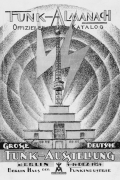 First Funkausstellung (Radio Show) is held in Berlin. It attracts 114,000 visitors. First Funkausstellung (Radio Show) is held in Berlin. It attracts 114,000 visitors. |
|
| December 24 | Nederlandse Christliche Radio Vereeniging (NCRV) begins radio transmissions in the Netherlands. | |
| December | First experimental facsimile transmission of images is sent from Caernarfon, Wales to the USA; the images mounted on a cylinder were scanned by light beam and received on similar equipment. | |
| December | Live reporting of a cricket Test Match between Australia and England is broadcast on 2BL Sydney. Commentators Hyam Marks and Clem Hill observe from within the new scoreboard. | |
| December | Newly formed Sovkino becomes responsible for all film activity in the Russian Federation; similar organisations are created in other Soviet republics. It is intended to be financially self-sufficient and eventually 'profitable'. | |
| • | Mezhrabpom film production company is set up in the USSR with financial and technical support from Internationale Arbeitshilfe (International Workers' Aid), a German communist group, which also sets up a German-Soviet distribution company, Prometheus, in Berlin. [0036] | > 1935 |
| • | Bell Laboratories perfects the Western Electric (Westrex) recording system. | |
| • | Magnascope wide-screen process, using a wide-angle projector lens, is demonstrated in public by its inventor, Lorenzo Del Riccio. | |
| • | An aeroplane hangar at Gladstone Road, Southall in west London is converted into a film studio by British producer G B Samuelson. [0019] | |
| • | Paramount becomes the first of the major Hollywood studios to release a two-strip Technicolor production, Wanderer of the Wasteland. | But see 1922 December 3 |
| • | Famous Players-Lasky withdraws from its UK investments and sells its Islington studio to producer Michael Balcon, who founds Gainsborough Pictures around the same time. Alfred Hitchcock moves onto the writing and production side. [0019] | |
| • | Association of Revolutionary Cinematography (ARC) is formed in Moscow. Led by Sergei Eisenstein and Lev Kuleshov, its members include most of the leading Russian film-makers. | |
| • | FEX (Factory of the Eccentric Actor), formed in 1921 in Leningrad by Grigory Kozintsev and Leonid Trauberg as a theatre workshop, becomes a cinema collective. It is effectively defunct by 1926. | |
| • | Mutual film distribution pact is made between Germany’s Ufa and Etablissements Aubert of France. | |
| • | Istituto LUCE (L’Unione Cinematografica Educativa) is founded in Rome to produce documentaries. | |
| • | First film made in Dominican Republic: Las Emboscados de Cupido, directed by Francisco Palau. | |
| • | First Indian film co-production: Savitri, made by Madan Theatres of Calcutta and U C Italiana of Rome. | |
| • | Aerial photographic survey of 1,000 square miles of the swampy Irrawaddy region is carried out by British airmen to produce maps. | |
| • | MPPDA (Hays Office) issues its self-regulatory ‘Formula’ for voluntary script vetting. | |
| • | At the year end 2.5m radio receivers are in use in the USA. | |
| • | Beam system of directional radio antennae is developed in the UK by C S Franklin of the Marconi Company. | |
| • | Vladimir Kosma Zworykin (1889-1982) applies for a patent on his iconoscope. | |
| • | Dr Kurt Stille (1873-1957) develops a dictation machine using similar principles to the Telegraphone, recording on steel wire. It is manufactured by Vox Gramophone Company. | |
| English physicist E V Appleton (1892-1965) shows that very short radio waves are not reflected by the Heaviside layer in the atmosphere. |
Page updated 13 November 2008
© David Fisher