






|
|
|
|
|
|
|
|
|
|
|
|
| 1929 |  Chronomedia index Chronomedia indexNumbers after entries link to the list of references. |
links and notes |
| Cultural highlights | Predictions made this year | ||
| January 2 | Australia's Censorship Board and Appeals Board, created following the Royal Commission on the film Industry in 1927, come into operation | |
| January 4 | Radio Corporation of America and the Victor Talking Machine Company agree to a takeover in which, although described as 'a new joint company', the latter becomes the RCA Victor division of the former (which acquires Marconi patents). RCA pays $5 cash plus one share of common stock and one of $5.00 preferred stock for each share in Victor. Victor had made a net profit of $7,324,019 in 1928. | |
| January 8 | The Singing Fool opens at the Piccadilly Cinema, Denman Street, London. | |
| January 10 | First appearance in print of Tintin, the cartoon character drawn by Hergé (Georges Remi, 1907-1983). | |
| January 16 | First edition of the BBC publication The Listener. | |
| January 17 | First appearance in newspaper comic strip form of Popeye the Sailor Man by Elzie Crisler Segar. | > 1935 |
| January 18 | Walter Winchell, a columnist on the New York Daily Mirror, makes his first radio broadcast. | |
| January 21 | Paramount talkie Interference opens at the Plaza Cinema, Piccadilly Circus, London. | |
| January 20 | Fox releases In Old Arizona in US cinemas, the first all-talking Western to be shot outdoors on location. | |
| January | Opening of The Jazz Singer in Paris. | |
| February 1 | MGM's musical The Broadway Melody opens at Grauman's Chinese Theater, Los Angeles. Some sequences are in Technicolor, Among 14 live acts preceding the film is George Gershwin playing Rhapsody in Blue. The film grosses $4.3m worldwide, yielding a net profit for MGM from its first musical of $1.6m. The songs (by Nacio Herb Brown and Arthur Freed) become repertoire standards. | |
| early February | Electrotone, a company based in Leeds, Yorkshire, begins making short films of artistes miming to their own audio records. By the end of the year almost 100 titles have been issued, directed by Dave Aylott and E F Symmons. | |
| February 18 | French government officially recognises 12 private radio stations operating in the country. | |
| February 27 | France's Chambre Syndicale decides to change the American film import quota from a ratio of seven imports for each French film to three. The Motion Picture Producers and Distributors Association (MPPDA) refuses to negotiate, preferring to implement a high tariff—a strategy that would favour its members over all others without giving French films an entrée to the US market. [0041] | |
| late February | Cinema sound installations in the US are being completed at a rate of around 250 a month. Western Electric has over 1,250 unfilled orders. [0025] | |
| February | Gaumont-British assumes control of Provincial Cinematograph Theatres (PCT), taking the size of its circuit to 287 screens. | |
| early | Technicolor requires a non-returnable deposit of $25,000 per picture to moderate demand. A total of 64 deposits are paid, including 20 from Warner Bros, giving Technicolor $1.6m. | |
| • | Stages at Gaumont British studios are wired for sound by chief Vitaphone engineer Stanley Watkins. | |
| March 3 | William Fox acquires a one-third stake (443,000 shares at $125 each) in Loew's, the controlling company of MGM, from Marcus Loew's widow, plus 227,000 more shares for $20m, giving Fox just over a majority share. | |
| March 4 |  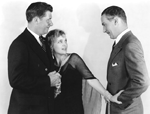 Fox's talkie In Old Arizona opens at the Empire Cinema, Leicester Square, London. It runs for six weeks. Another talkie, The Wolf of Wall Street [right] is shown at the Plaza Cinema, Piccadilly Circus, London. Fox's talkie In Old Arizona opens at the Empire Cinema, Leicester Square, London. It runs for six weeks. Another talkie, The Wolf of Wall Street [right] is shown at the Plaza Cinema, Piccadilly Circus, London. |
|
| March 12 |  Première of Melodie der Welt, the first talkie made in Germany. Première of Melodie der Welt, the first talkie made in Germany. |
See also November 22—which contradicts this entry |
| March 18 | Another talkie, The Canary Murder Case, opens at the Plaza Cinema, Piccadilly Circus, London. | |
| March 28 | A letter to The Times from the British Postmaster General advises that, although there will be no restrictions placed on the sale of Baird Televisors, ‘the purchaser must understand that he buys at his own risk, at a time when the system has not reached a sufficiently advanced stage to warrant its occupying a place in the broadcasting of programmes. | |
| March | Klangfilm and Tobis combine to compete against American sound film technology, presenting a strong European alternative by claiming all German patent rights in sound film and thereby sparking a patents war. Tobis-Klangfilm also forms a production subsidiary in France. | |
| March | Technicolor has orders for productions over 10 months amounting to 6.8m feet of negative and five times that quantity for prints. Prints cost eight cents a foot, compared with two cents for monochrome. | |
| March | Last issue of The Australasian Gazette silent cinema newsreel. | > November 2 |
| March | Baird demonstrates 30-line television to the BBC at Savoy Hill. | |
| April 4 | Governmental conference, proposed by Czechoslovakia to regulate broadcasting frequencies in Europe convenes in Prague. Hitherto agreement has been made only between broadcasters. | > April 13 |
| April | Warner Bros premieres a programme of short 'talking films in languages other than English' (French and German) in Berlin and Paris. | |
| April 10 | US film company members of the Motion Picture Producers and Distributors Association (MPPDA) implement a boycott of the French market. [0041] | > September 24 American film boycotts American film boycotts |
| April 13 | Prague Plan allocates wavelengths for use by broadcasters in Europe. Agreement is reached between 27 post and telegraph administrations, eight abstain. | < April 4 > June 30 |
| April 26 | Warner Bros decides to break the boycott of French cinemas unilaterally to gain advantage but is pressured by the MPPDA not to break ranks. [0041] | |
| April 29 |  Musical film Show Boat (subsequently re-made in 1936 and 1951) opens at the Tivoli Cinema in the Strand, London. Musical film Show Boat (subsequently re-made in 1936 and 1951) opens at the Tivoli Cinema in the Strand, London. |
|
| May 1 | Construction begins of the Ufa sound studios at Neubabelsberg in the suburbs of Berlin. Four sound stages are arranged in the form of a cross ('Tonkreuz'). | > September 24 |
| May 11 |  MGM's Broadway Melody musical, with Technicolor scenes, opens at the Empire Cinema, Leicester Square, London. It runs for three months. MGM's Broadway Melody musical, with Technicolor scenes, opens at the Empire Cinema, Leicester Square, London. It runs for three months. |
|
| May 16 | Academy of Motion Picture Arts and Sciences holds its first Academy Awards presentation in Hollywood. (The term ‘Oscar’ is first used in 1931.) Best film is Wings (Paramount); best actor Emil Jannings, best actress Janet Gaynor. The statuette is designed by Cedric Gibbons, art director at MGM, and manufactured by Dodge Trophy Company of Crystal Lake, Illinois; it measures 13 inches high and weighs 8 lb. | |
| May 20 | Mother's Boy, a talking picture starring Morton Downey, opens at the Palace Cinema, Cambridge Circus, London. | |
| May 28 | Warner Bros’ full-length colour talkie On with the Show is premiered at the Winter Garden, New York, using two-colour Technicolor and Vitaphone sound. | |
| May | MGM makes a three-reel 'featurette' with dialogue in French and Spanish. | |
| May | RCA Victor issues the first catalogue of country music: 800 titles under the name Victor Records of Native American Melodies. | |
| June 3 | The Singing Fool opens at the Gloria Palast cinema in Berlin, the first American sound film shown in Germany. In the first six days it is seen by over 30,000 people. | |
| June 9 | First edition of British Movietone News cinema newsreel, with the slogan ‘It speaks for itself’. It is the result of a collaboration between the American newsreel Fox Movietone News and Esmond Harmsworth, later 2nd Viscount Rothermere, of the family that founded the Daily Mail and Daily Mirror. | |
| June 12 | Riots occur in Poland over films with German subtitles. [0041] | |
| June 17 | 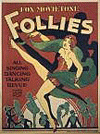 Movietone Follies opens at the New Gallery Cinema, Regent Street, London. Movietone Follies opens at the New Gallery Cinema, Regent Street, London. |
|
| June 21 | 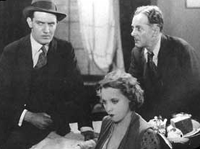 Alfred Hitchcock’s Blackmail, is premiered at the Regal Cinema, Marble Arch, London. Claimed to be the first British talkie, made by British International Pictures, it also includes an early (first?) example of dialogue re-voicing (dubbing). Alfred Hitchcock’s Blackmail, is premiered at the Regal Cinema, Marble Arch, London. Claimed to be the first British talkie, made by British International Pictures, it also includes an early (first?) example of dialogue re-voicing (dubbing). |
|
| June | In Paris Paramount completes a feature film starring Maurice Chevalier with dialogue in four languages. | > year end |
| June 30 | Prague Plan for allocation of radio broadcasting frequencies in Europe comes into effect. | |
| July 1 |
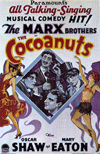 The British talkie The Unwritten Law opens at the Capitol Cinema, Haymarket, London on the same day that the Marx Brothers talking comedy The Cocoanuts opens at the Carlton Cinema, Haymarket. The British talkie The Unwritten Law opens at the Capitol Cinema, Haymarket, London on the same day that the Marx Brothers talking comedy The Cocoanuts opens at the Carlton Cinema, Haymarket. |
|
| July 8 | Fox dialogue film Through Different Eyes opens at the Astoria Cinema, Charing Cross Road, London. | |
| July 9 |  Erich von Stroheim's film The Wedding March, made in the USA with sound on disc, is the opening film at the Mozartsaal cinema in Berlin. Erich von Stroheim's film The Wedding March, made in the USA with sound on disc, is the opening film at the Mozartsaal cinema in Berlin. |
|
| July 13 | Warner Bros releases the Vitaphone production On With the Show!, the first all-talking musical shot entirely in Technicolor. | |
| July 29 | Hitchcock's Blackmail goes on official release in London at the Capitol, Haymarket. It runs for eight weeks. | |
| July | Flying spot colour scanner with three banks of photocells (for red, green and blue) is demonstrated over a short telephone link by Dr Herbert E Ives of Bell Laboratories. Neon and argon lamps are used at the receiving end. | |
| August 19 | Baird transmits a commercially made film, The Bride—a monologue by the comedian George Robey—from his studios in Long Acre, London. | |
| August 23 | Première of the first Austrian talkie, G’schichten aus der Steiermark (Tales from Styria), directed by Hans Otto Löwenstein for Eagle Film and Ottoton Film. | |
| August | Two-way sound and vision video telephone service is demonstrated at the Berlin Radio Exhibition by G Krawinkel on behalf of the German Post Office. | |
| September 1 | Warner Bros and Paramount announce a consortium to be called Paramount Vitaphone to pool 1,400 cinemas, Columbia Records, CBS radio and six film studios. Within the month the deal is dropped when the Department of Justice threatens anti-trust action. | |
| September 24 | Agreement between French and American negotiators keeps the previous agreement of a 7:1 ratio for imported and local film releases in place until 1 October 1930 and for a further year if no replacement is agreed by 1 May 1930. The boycott is lifted. This allows up to 1,200 US imports against a market requirement of about 800 releases overall. It is assumed that the language barrier created by the advent of sound will protect French producers. [0041] | |
| September 24 | Ufa's sound stages at Neubabelsberg are handed over for the start of production. | > December 16 |
| September | The Fox Movietone Follies of 1929, the first film made in the Fox Grandeur 70mm wide-screen process, is shown on a 28ft x 14ft screen at the Gaiety Theater, Broadway, New York. | |
| September | The Aird Committee’s report on Canadian broadcasting is tabled before the House of Commons in Ottawa. Its main proposals are the establishment of a coast-to-coast national service from seven high-power transmitters plus some local in-fill, funded by a $3.00 license receiving fee and sponsorship (a company name may be mentioned, but no advertising of products). Programme content is to be mainly Canadian, but the issue of provincial against federal control is not clear. All private stations are to be expropriated. | |
| September | In a paper for the Institute of Radio Engineers, Weinberger, Smith and Rodwin propose that the aspect ratio of television should be determined by that used for the cinema and, because the sound track has reduced the width of the picture area on film, proposes a ratio of 6:5. | |
| September 30 | Start of daily experimental picture-only 30-line television transmissions by Baird from his studio at 133 Long Acre, in the presence of the President of the Board of Trade, William Graham, via the BBC’s 2LO transmitter. | |
| • | Fox Film Company acquires Loew’s, the owner of MGM but the federal government vetoes the deal. | |
| • | Associated Talking Pictures is established, soon to be based at Ealing Studios, West London. | |
| October 2 | NBC Radio first broadcasts The National Farm and Home Hour, a mixture of entertainment and adviced for rural dwellers. | |
| October 21 | First twin-wave station of the BBC’s regional scheme, at Brookman’s Park, is brought into service. | |
| October 28 |  Berlin premiere of Atlantik, a British-German co-production made at British International Pictures' Elstree Studios and directed by E A Dupont in separate English and German versions (a French version is made early in 1930) but reckoned to be the first German-language talkie to be released. Berlin premiere of Atlantik, a British-German co-production made at British International Pictures' Elstree Studios and directed by E A Dupont in separate English and German versions (a French version is made early in 1930) but reckoned to be the first German-language talkie to be released. |
|
| October 30 | Entertainment trade paper Variety reports the stock market crash with the headline 'Wall Street Lays on Egg'. | |
| October 31 | First French talkie to be premiered is Les Trois Masques, starring Marcel Vibert and Renée Heribel, directed André Hugon for Pathé-Natan. Despite being generally regarded as a mediocre film it proves a popular success. | October | US studios begin to use dubbing to produce foreign-language versions of film releases but the technique is crude and not very effective. [0041] |
| November 1 | Thomas A Edison Inc ceases production of records and phonographs and withdraws from the audio entertainment market to concentrate on making radio receivers and dictating machines. | |
| November 2 | First news cinema—the Embassy on Broadway, New York—opens. It closes in 1949 'owing to the competition from television'. | |
| November 2 | First issue of Australian Movietone News sound newsreel includes a speech by prime minister J H Scullin. | < March |
| November 3 | Marconi-Wright facsimile system, using super high-speed Morse telegraphy, is demonstrated; documents and images could be transmitted across the Atlantic within three minutes. The earliest enthusiastic users are newspapers. | |
| mid November | MGM announces a $2m plan to make foreign-language films in French, German and Spanish, as well as English, by re-shooting dialogue scenes in Hollywood with imported actors. Production budgets are $85,000-$125,000—far more than typical French box office receipts. [0025, 0041] | > April 1931 |
| end November | MGM announces a $2m programme to bring foreign actors to Hollywood to make French, German and Spanish versions of films. | |
| November 18 | V K Zworykin demonstrates a television receiving system of essentially surviving design to the Institute of Radio Engineers in the US. Called the Kinescope, it scans motion picture film. | |
| November 21 | Berlin premiere of Die Königsloge, an all-talking German-language film, starring Alexander Moissi and shot by Warner Bros in Brooklyn, New York (see also October 28). | |
| November 22 | Berlin premiere of Dich hab’ ich geliebt, first German-language talkie shot in Germany (see also March 12—which contradicts this entry). It is released in the US as Because I Love You. | |
| December 9 | Fire, caused by seven explosions, destroys Pathé's sound film studio in New York City. Ten people (four technicians, four female dancers and on unidentified) are killed out of around 100 in the building at the time. | |
| early December | Three nights of rioting greet the opening of Fox Movietone Follies of 1929 at the Moulin Rouge, PAris, 'the mob tearing up carpets and seats and demolishing everythiing breakable about the place' (Variety). Audiences of up to 1,500 people has not been warned that the film was in English. [0041] | |
| December 9 | In Nice, France, rioters rip out cinema seats during a screening of Les Innocents de Paris. [0041] | |
| December 12 | British Broadcasting Company is wound up. | |
| December 16 | Premiere of the first Ufa sound film, Melodie des Herzens, produced by Erich Pommer, at the Ufa Palast am Zoo cinema in Berlin. | |
| December 16 | The first British all-talking feature film is The Clue of the New Pin, made by British Lion at Beaconsfield Studios from an Edgar Wallace novel. Among the bit part players is John Gielgud. | |
| December | A conference is held in Paris to reach international agreement on excluding educational films from import duties. The MPPDA, representing US producers, argues for limiting the definition of educational films: 'All our entertainment films are educational,' says Harold L Smith, the MPPDA Paris representative. [0036] | |
| end | Paramount embarks on a $10m project to make films in five languages from a Paris studio base headed by producer Robert Kane. | > 1930 March |
| end | In film studios microphone booms—pivotable counter-balanced arms on stands—begin to replace microphones hanging from the studio lighting grid on wires or hidden on the set. | |
| • | Crane mount for a film camera is used on the production of Broadway (Universal). | |
| • | William Fox takes over the Embassy cinema on Broadway, New York and changes its programming policy to a one-hour cycle of newsreels and other short films, including cartoons. The admission charge is 25 cents rather than the usual $2.00. This is claimed as the first news cinema in the USA. | < 1909 May 23 |
| • | British and Dominions Film Corporation spends £250,000 installing Westrex sound film production facilities in its Imperial Studios at Elstree. A team under Stanley Watkins is sent by Western Electric from the US to the UK to convert studios. Gaumont-British’s Shepherds Bush Studios are rebuilt for sound production at a cost of £500,000. [0019] | |
| • |  German Telegraphie-Patent Syndikat, launched by entrepreneur-inventor Dr Kurt Stille, sells the rights in his steel tape dictation machine, a development from the Telegraphone, to British film producer Louis Blattner. German Telegraphie-Patent Syndikat, launched by entrepreneur-inventor Dr Kurt Stille, sells the rights in his steel tape dictation machine, a development from the Telegraphone, to British film producer Louis Blattner.Renamed the Blattnerphone, this first magnetic tape recorder uses 6mm steel tape running at 5 feet per second, giving around 20 minutes recording time from a reel of just over a mile of tape, weighing 21 lbs. It is introduced for adding sync sound to films at Blattner Colour and Sound Studios, Elstree, near London. (The recorder is also known as the Blattner-Stille machine.) |
|
| • | Of 290 films released by the seven Hollywood majors, only 38 are silent—13 per cent, compared with 75 per cent in 1928. Three companies make no silents: Fox, United Artists and Warner Bros. All-talking pictures total 166, a further 50 were part-talkie and 36 have music and sound effects without dialogue. Paramount releases both the most talkies (47) and the most silents (13). |  Hollywood goes for sound Hollywood goes for sound |
| • | By the year end there are 6,000 cinemas wired for sound in the US, 400 in the UK and about 10 in France. | > 1942 |
| • | Of 395 films released in Denmark, only three are Danish. US productions account for 74 per cent of the Danish market and German films 20 per cent. | > 1942 |
| • | Six two-strip Technicolor films are released—half as many again as ever released before—including three from Warner Bros (Gold Diggers of Broadway, On with the Show and The Show of Shows), two from MGM (The Mysterious Island and The Viking, the latter co-produced with Technicolor Corporation) and one, Mamba from independent producer Tiffany. | |
| • | Consolidation in the French film production sector: three companies merge to become Gaumont-Franco-Film-Aubert (the latter being part of the 1924 Franco-German agreement with Ufa). Also, Pathé and Nathan merge to become Pathé-Nathan. | |
| • | Italian law prohibits the exhibition of films in any language other than Italian. Portugal and Spain briefly follow suit. | |
| • | Kapal Kundala, made by Madan Theatres of Calcutta, is the first Indian film to achieve a ‘silver jubilee’ run of 25 consecutive weeks—standard measure of success in the Indian film industry. | |
| • | New Babylon, the silent film by Grigory Kozintsev and Leonid Trauberg features a musical score by Dmitri Shostakovich—one of the last silent films to have music written by a leading composer. | |
| • | Eight sound films are made in UK during year. Various estimates are given for wiring of cinemas for sound: one source says 22 per cent of cinemas (980 of them during the year), another gives 500 as the total. | |
| • | France has 4,200 cinemas, of which around three-quarters are part-time, small and usually rural houses—not purpose-built—and open only at weekends. [0041] | |
| • | At the year end, Gaumont-British now has 280 screens in its Gaumont cinema chain. | |
| • | Associated Radio Pictures Corporation buys the existing film studios at Ealing in west London. The chairman of ARPC is actor Sir Gerald du Maurier; another director is theatrical producer Basil Dean. [0019] | > 1931 |
| • | Fire destroys the small De Forest Phono Films studio at Wembley and partly destroys Teddington Studios. [0019] | |
| • | Baird Television Development Company opens an additional laboratory at Kingsbury Manor, near Wembley. | |
| • | Whitehall Films opens Whitehall Studios at Elstree, the fourth studio in the district. It is next to the railway station and someone is employed to watch from the roof to warn of approaching trains and halt filming. [0019] | |
| • | There are now 83 film production companies in Germany. | > 1934 |
| • | Four wide-screen film formats are considered by the Standards Committee of the Society of Motion Picture Engineers (SMPE) including 35mm with 10-perforation horizontal pulldown and 70mm, with aspect ratios ranging from 1.85:1 to 2.27:1. | |
| • | Australian feature production, affected by both the failure of the 1927 Royal Commission to have any effect and by the financial and technical implications of the introduction of sound, are at the lowest level since 1909. | |
| • | First Canadian talkie is North of ‘49, directed by Neal Hart for British Canadian Pictures. | > 1943 |
| • | Vsevelod Pudovkin gives a lecture in London entitled ‘Model instead of actor’ to describe effects in formalist montage theory pioneered by Lev Kuleshov but hereafter ascribed in the West to Pudovkin. | |
| • | International Congress of Avant-garde Film is held at La Sarraz, Switzerland. Among those present are Sergei Eisenstein, Alberto Cavalcanti, Ivor Montagu, Béla Balázs and Hans Richter and Walter Ruttman. | |
| • | In the Soviet Union, ARC is renamed the Association of Workers of Revolutionary Cinematography (ARRC) with the aim of supporting the cultural revolution by making ‘100 per cent proletarian ideological film’. | |
| • | The surface of the moon, featuring the Copernicus crater, is filmed at Princeton University in the US, using a 23-inch telescope. The 50-foot long film is recorded at the rate of one frame every six seconds. | |
| • | Practical cable relay of radio programming is announced by the US National Academy of Sciences as a way of reducing airwave congestion. General G O Squier calls his invention 'wired wireless' or the 'monophone'. Power consumption is small: the equivalent to a small incandescent lamp will provide power to deliver signals to 5,000 homes. | |
| • | Marconi Company in UK sells all radio receiver and other ‘home entertainment apparatus’ patents to the Gramophone Company, now controlled by the Victor Talking Machine Company. | |
| • | BBC publishes Broadcast English I: Recommendations to announcers regarding certain words of doubtful pronunciation. The booklet is also incorporated, with comments, by the Society for Pure English in its Tract no XXXII. The latter runs to two further impressions within as many years, testifying to the interest in the subject. | < 1926 Broadcast English Broadcast English |
| • |  Radio Fécamp, French commercial station, changes its name to Radio Normandie (in English: Radio Normandy). Radio Fécamp, French commercial station, changes its name to Radio Normandie (in English: Radio Normandy). |
Click on the picture for more about Radio Normandie |
| • | Radio Toulouse in France begins commercial broadcasts in English, the programmes being sponsored by UK record companies. | |
| • | 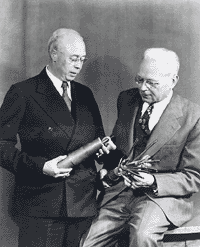 Coaxial cable, in which the signal-carrying central core is surrounded by insulation and then a second concentric physical layer in the form of a mesh, is invented by Lloyd Espenschied and Herman Affel of the Bell Telephone Laboratories [right]. Several coaxial cable can be grouped within the outer sheath. Coaxial cable, in which the signal-carrying central core is surrounded by insulation and then a second concentric physical layer in the form of a mesh, is invented by Lloyd Espenschied and Herman Affel of the Bell Telephone Laboratories [right]. Several coaxial cable can be grouped within the outer sheath.Source of picture: AT&T |
> 1939 |
| • | Decca Record Company is founded in the UK with a strategy of releasing cheaper records: classical releases for 3s 6d (17½p), compared with HMV Red Label at 6s 6d (32½p). Most of its classical releases are acquired under licence from Polydor. The name Decca has been used previously for a portable gramophone introduced during the First World War. | |
| • | Scottish Daily Express newspaper is launched and printed in Glasgow. |
Page updated 22 July 2009
© David Fisher