| 1931 |
 Chronomedia index Chronomedia index
Numbers after entries link to the list of references. |
links and notes |
| |
Cultural highlights | Predictions made this year |
|
| January 3 |
First issue of Motion Picture Herald, formed by the merger of Exhibitors' Herald World and Motion Picture News, is published. |
|
| January 4 |
Baird demonstrates ‘zone television’, showing full-length figures and a cricket lesson by Herbert Strudwick. |
|
| January |
BBC rents a steel-tape recorder from the British Blattnerphone Company. It costs £500 for the first year and £1,000 for subsequent years of the five-year agreement. Additional machines will cost £250 a year. |
|
| January |
Australian Movietone News splits into a fully Australian edition, with a separate reel of international stories edited for the Australian market. |
|
| January |
British Kinematograph Society (BKS) is formed for film technicians, principally to keep members informed of the latest technological developments. It has grown out of the London Section of the Society of Motion Picture Engineers (SMPE) which had been at loggerheads with the American parent organisation. |
|
| January 27 |
Clara, Lu 'n' Em is first broadcast on NBC Blue network in the US in an evening slot, prior to moving to daytime at the start of the soap opera boom. |
> 1932 |
| February 12 16:20 |
 Inauguration of Vatican Radio by Pope Pius XI (extreme right of the photograph) and Guglielmo Marconi (in the top hat). The first transmission, after the power switch is thrown by the Pope, begins with the morse message 'In nomine domini, amen', after which Marconi briefly introduces the Pope, who speaks in Latin. [0043] Inauguration of Vatican Radio by Pope Pius XI (extreme right of the photograph) and Guglielmo Marconi (in the top hat). The first transmission, after the power switch is thrown by the Pope, begins with the morse message 'In nomine domini, amen', after which Marconi briefly introduces the Pope, who speaks in Latin. [0043] |
|
| March 1 |
De Forest Radio Corporation begins regular transmissions of travel and documentary film shorts from W2XCD television station at Passaic, NJ. |
|
| March 6 |
Baird first includes film material in his test programmes, beginning with a five-minute test film of a boxing match, followed on 9 March by a Chaplin/Keystone Kops film. |
|
| March 6 22:30 EST |
First broadcast of The March of Time news magazine programme
on CBS radio network in US, relayed by the BBC in the UK. |
|
| March 14 |
Release of the first feature-length Indian talkie, Alam Ara, directed in Hindustani by Ardeshir Irani (1886-1969) for his Imperial Film Company; lead actress is Fatma Begum (see 1926). Irani also produces the first Tamil-language film, Kalidasi, later in the year. |
See also 1933 and 1937 |
| • |
First talkies made in
• Argentina: Muñequitas Porteñas, using the Vitaphone system;
• Finland: The Log-driver’s Bride, directed by Erkki Karu. |
|
| March |
The Gramophone Company, Columbia Graphophone Company and others merge to form Electrical and Musical Industries (EMI). RCA at this time has a controlling interesting in the Gramophone Company. |
|
| early April |
Three US cinema circuits, Fox, Loews and RKO announce they will not show advertising films on their screens. Paramount is showing no more than one commercial a week—made by Paramount Business Films— in Publix cinemas. Warner Bros is screening only commercials made by its own industrial film department. |
|
| April 6-11 |
W2XCD, Passaic, NJ, the De Forest television stations, transmits a full-length feature film, Police Patrol (made in 1925) in six daily episodes. |
|
| April 14 |
René Barthélemy (1889-1954), head of the Compagnie des Compteurs television research laboratory at Montrouge near Paris, demonstrates a 30-line television system at the Ecole Supérieure d'Electricité (Supelec) at Malakoff, France in a transmission from Montrouge. The camera uses a Weiller mirror drum and the receiver a Nipkow disc. |
|
| April |
Japan’s Second Radio Network comes into operation. |
|
| April |
MGM closes its foreign-language film production units. |
< November 1929 |
| April 24 |
Lee De Forest files a US patent for a method of recording pictures, film or events ‘at the receiver by the etching action of an electrical discharge upon a suitable coating applied to a moving picture film or strip. The variable impulses of a video signal activites a series of needle points arranged around a revolving wheel. The varying pressure of the needle points on the surface of a 35mm film coated with pure metallic silver etches the image onto the film, which can then be displayed by means of a conventional motion picture projector.' The recording system is part of a research project to develop a large-screen television mechanism capable of projecting full-sized motion pictures. The project is abandoned due to the Depression, when the goal of theatre television was in sight. |
|
| May 8 |
Baird transmits pictures of available-light street scenes, using a mirror-drum scanner mounted in a van. About now Baird forms a new company, Baird Television Ltd. As well as developing the television imaging and broadcasting technology, the company also produces kits from which to make receivers. |
 Click for more about receiver kits Click for more about receiver kits |
| May |
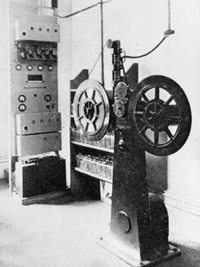 BBC moves its Blattnerphone steel-tape audio recorder to its Savoy Hill studios and brings it into practical use. [0005b] BBC moves its Blattnerphone steel-tape audio recorder to its Savoy Hill studios and brings it into practical use. [0005b] |
> 1932 |
| May |
In the US, 5,042 cinemas still have sound-on-disc only systems. [0005b] |
|
| June 2 |
Television transmission is made by Baird of scenes from Derby horse racing at Epsom. |
|
| June 18 |
A levy of 10 per cent of box office revenue is imposed on Italian cinemas by Law 918, the funds to be used to ‘aid all sectors of the film industry and in particular to reward those with a proven ability to cater for the tastes of the public’. |
|
| July 27 |
BBC Theatre Orchestra makes its first production. |
|
| August |
Estimated 9,000 television receivers are in use in New York and 30,000 in the rest of the US. |
|
| • |
High Court rules that under the Sunday Observance Act 1780 local authorities in England and Wales may not grant licences for Sunday cinema opening. |
> 1932 |
| September 3 |
Bing Crosby gets his own show, Fifteen Minutes with Bing Crosby, on CBS radio. In Hollywood the show is recorded in full by RCA Victor on behalf of NBC on a (yet to be made public) 16-inch 33rpm disc and in sections on 12-inch 78rpm discs, probably by placing a microphone in front of a radio set's speaker. |
|
| September 17 |
RCA-Victor demonstrates 16-inch 33-1/3 rpm long-playing discs and gramophones at the Savoy Plaza Hotel, New York. Playing time is 14 minutes a side but radiograms incorporating the idea and selling at $250 do not catch on. |
|
| September 25 |
First Hungarian talkie, A Kék Bálvány, directed by Lajos Lázár, is premièred. |
|
| September |
First edition of The Herald Newsreel is shown in Australian cinemas. It is a co-production between Herschells Films and the Melbourne Herald on the initiative of the latter’s proprietor, Keith Murdoch. |
> September 1932 |
| October 11 |
First programmes produced from London by the International Broadcasting Company (IBC) are transmitted: a Special Concert for the Benefit of British Listeners from Radio Normandie at Fécamp at 20:00 and The Vocalion Concert of Newly Released Broadcast Records from Radio Toulouse at 22:30. The latter was the first sponsored programme, paid for by the Vocalion record label. Programmes continue to be transmitted on Sundays. |
IBC: > November 29
 more on Radio Normandie more on Radio Normandie |
| October 24 |
Ulysses A Sanabria gives a cinema-television demonstration at the B S Moss Broadway Theatre in New York. The 45-line image dissected by a scanning disc 3.5 ft in diameter with a spiral of 45 two-inch lenses produces an image 10ft square. |
|
| October |
Price of a complete Baird 'Televisor' receiver is reduced to 18 gns (£18.90) and 12 gns (£12.60) for a complete kit of parts for home construction. |
|
| November 1 |
Television images are transmitted from JOAK radio station in Tokyo, Japan by Professors Kenjiro Takayagani and Tomomasa Nakashima. The images comprise 80 scanning lines at a rate of 20 frames per second. |
|
| November 7 |
First edition of Australian cinema newsreel Cinesound Review includes coverage of the Melbourne Cup. Produced by Greater Union’s Cinesound Studios, the newsreel survives until October 1970. |
|
| November 22 |
Radio Normandie broadcasts its first English-language sponsored programme, the Philco Slumber Hour. |
|
| November 29 |
Radio Paris transmits its first programme produced from London by IBC, featuring HMV record releases. |
|
| November |
RCA Victor releases its first 33-1/3 rpm LP: Beethoven’s Fifth Symphony performed by the Stokowski-Philadelphia Orchestra under Leopold Stokowski. |
|
| December |
Alan Dower Blumlein of Electrical and Musical Industries (EMI) at Hayes, Middlesex, UK, files a provisional patent application (patent 394 325) for stereophonic sound recording and reproduction on disc and film. |
> 1935 |
| December 18 |
BBC Chamber Orchestra makes its first broadcast. |
|
| December |
EMI is granted a licence for experimental (mechanical) television transmissions. |
|
| December |
Henri de France begins test television transmissions from Radio Normandie. |
> 1932 |
| December |
William Fox's patents for the Tri-Ergon sound system are granted, leading to Fox filing actions against ERPI, Paramount, RCA and RKO (but not Fox Studios, to which he had licensed Tri-Ergon). |
|
| December |
Bell Laboratory engineers in US record orchestra with reasonable high fidelity; stereo sound is added by spring 1932. |
|
| December |
American West Coast station W6XAO begins regular television broadcasts consisting entirely of motion picture film transmissions, using an all-electronic scanning system. Live programming is added only in 1940 |
|
| late |
First Soviet film stock factories open. Within a year all needs are met and imports cease. [0036] |
|
| • |
US Federal Radio Commission rejects use of Baird’s television system because it is ‘alien’. |
|
| • |
 Transmitter on the Empire State Building [left] in New York is brought into use. Transmitter on the Empire State Building [left] in New York is brought into use. |
|
| • |
AEG takes up Pfleumer’s efforts to produce paper-backed or plastic tape for audio recording. |
|
| • |
German firm I G Farben develops coated magnetic tape. |
|
| • |
International Eidophon Company is founded with backing from the Roman Catholic Church to exploit patents in sound film production held by a priest. |
|
| • |
Telegrams of up to 15 words can be transmitted from the aeroplanes of Berlin-Vienna airways to various places in Germany, Austria and Czechoslovakia. |
|
| • |
Associated Radio Pictures Company builds a new studio on its site at Ealing, west London. It is claimed to be UK’s first purpose-built sound film studio. Ealing Studios has seven stages installed with RCA sound equipment. [0019] |
|
| • |
Warner Brothers and First National leases and later buys Teddington Studios and spends £100,000 on modernisation and extension. [0019] |
|
| • |
 RKO Pictures and Pathé Pictures merge their distribution businesses in the USA. RKO Pictures and Pathé Pictures merge their distribution businesses in the USA. |
|
| • |
Sound Services converts former industrial premises at Kingston Road, Merton in south London into a film studio. [0019] |
|
| • |
London has 258 cinemas with 344,000 seats, averaging 1,333 seats per screen. |
< 1931 |
| • |
The Era Challenge Cup is first awarded for the best amateur film of the year. There are 50 entries. |
|
| • |
Entertainments Censorship Act is passed in South Africa. |
|
| • |
GPO Investigation Service introduces detector vans to trace British radio licence evaders. |
|
| • |
Crosley system of radio audience ratings is introduced. |
|
| • |
Allan B DuMont leaves the DeForest Company to set up his own business researching and marketing cathode ray tubes and oscilloscopes. |
> 1939 April |
| • |
C F Jenkins produces his Radiovisor mechanical television receiver using a Nipkow disc. |
|
| • |
CBS has 82 radio stations and sales revenue of $10.4m, NBC has 83 stations and sales of $20.5m. |
|