






|
|
|
|
|
|
|
|
|
|
|
|
| 1932 |  Chronomedia index Chronomedia indexNumbers after entries link to the list of references. |
links and notes |
| Cultural highlights | Predictions made this year | ||
| January 24 | Radio Rome transmits its first English-language sponsored programmes made by IBC. | |
| January 31 | Radio Normandy increases its English-language programme schedule to nine hours on Sundays (18:00-03:00) and two hours on weekdays (23:00-01:00). | |
| January | Of 18,553 US cinemas, 14,405 are wired for sound; 4,128 silent cinemas and 1,925 sound cinemas have closed, many of them in cities most affected by the Depression. | |
| January | Isidore Ostrer of Gaumont British Picture Corporation acquires a controlling interest in Baird Television. | |
| February 1 | Television test transmissions from Radio Normandie are picked up in Le Havre. | |
| February 5 | First educational television programme is broadcast in the US by CBS’s W2XAB. | |
| February 15 | Comedy duo George Burns and Gracie Allen make their regular radio debut on The Guy Lombardo Show on CBS radio. They soon have their own show. | |
| February | In response to an appeal from the province of Quebec, the Imperial Privy Council in London rules that control of Canadian broadcasting should be at federal level. | |
| March 12 | Bell Laboratory engineers make hi-fi stereo disc recordings of Leopold Stokowski and the Philadelphia Orchestra playing Scriabin’s Poem of Fire (a recording released in limited edition in the 1980s). Two tracks are recorded separately on the same disc, one beginning at the edge and one part way across the radius, using the hill-and-dale cutting technique. | |
| March 12 | BBC Broadcasting House in Portland Place is first brought into use. | |
| March 15 | First broadcast from a studio at Broadcasting House is by the BBC Dance Orchestra under its new leader, Henry Hall. | |
| March 29 | Jack Benny's first radio appearance is in an interview with Ed Sullivan, who had himself begun his radio career at CBS on January 12. | > May 2 |
| March | Canadian Prime Minister R B Bennett announces a parliamentary committee to investigate and propose practical arrangements for a national broadcasting service. | |
| April 14 | Première of the first Egyptian talkie, Onchoudet et Fouad, directed by Mario Volpi. | |
| April 17 | Radio Normandy adds a children's programme, Children's Corner, to its English-language schedule. | |
| April 28 | ‘World’s first’ demonstration of ultra short wave (7.3m) television (BBC press release 29 April 1932). | |
| May 1 | Broadcasting House in Portland Place officially becomes the BBC's headquarters building. | |
| May 2 | The Jack Benny Show is first broadcast on NBC radio. Benny's fee: $1,400 a week. | < March 29 |
| May 19 | Baird Visiophone is demonstrated in Paris. | |
| May 26 | Canadian Broadcasting Act is passed, creating the Canadian Radio Broadcasting Commission (CRBC) to administer a national service with a monopoly on network broadcasting, although some private stations not required to form the national service are to continue operations. | |
| May | RCA demonstrates 120-line television on a cathode ray tube with better results achieved by scanning film than by direct imaging. | |
| May | Australian Broadcasting Commission is established by Act of Parliament, formalising an arrangement that had existed since 1929 under which the then Australian Broadcasting Company controlled the ‘A’ class stations, using technical services of the Postmaster General’s department; programmes were provided under contract by local stations. | |
| May | EMI starts to collaborate with Marconi to produce an electronic television system. | |
| May | BBC moves its Blattnerphone recorder to the seventh floor at Broadcasting House and soon acquires a second machine to allow continuous recording. [0005b] | |
| June 10 | In the UK, the Commission on Educational and Cultural Films publishes a report on The Film in National Life, recommending foundation of a national film institute. | |
| June 15 | Roger Frison-Roche broadcasts live from the summit of Mont Blanc using a portable transmitter. | |
| June 29 | Official re-opening of Gaumont British studios in Lime Grove, Shepherds Bush, west London. The site now has five state-of-the-art studios. | > 1941 October |
| June 29 | A second daytime soap begins on the NBC Blue radio network, Vic and Sade. | > October 10 |
| June | Baird transmits pictures of the Derby horse race at Epsom to a large-screen television display at the Metropole Cinema, London. The demonstration transmission is over 25 miles to a 30-line 9ft x 6ft screen. The projector consists of a mirror drum with Kerr cell modulation of the light. | |
| July 1 20:00 | Programmes of the newly created Australian Broadcasting Commission are inaugurated by the prime minister, Joseph Lyons. The ABC takes over eight main radio stations that form the national service: 2BL and 2FC in Sydney, 3AR and 3LO in Melbourne, 4QG in Brisbane, 5CL in Adelaide, 6WF in Perth, 7ZL in Hobart, plus four relay stations: 2CO at Corowa, 2NC in Newcastle, 4RK in Rockhampton and 5CK at Crystal Brook. Talks are given during the first year by King George V, Pope Pius XI, Adolf Hitler, British prime minister Ramsay MacDonald, G K Chesterton, J B Priestley and controversial English cricket captain D R Jardine. | |
| July 13 | The Sunday Entertainments Act receives the Royal Assent in the UK. As well as allowing local referendums on Sunday cinema opening—one of only five subjects so treated—it requires part of the takings from such opening to be paid to the Cinematograph Fund to be used for ‘encouraging the use and development of the cinematograph as a means of entertainment and instruction’; it goes to the British Film Institute. | > 1972 |
| July 29 | New French edict declares that only films dubbed in France may be distributed and that the number of cinemas eligible to screen foreign-language films is to be limited. |  Quotas and levies Quotas and levies |
| July | Baird Television Company begins working on an intermediate film system of television, a film original being rapidly processed and scanned as a negative by the television system. | |
| July | Paramount ceases production at its Joinville studio in Paris, using it for only dubbing of imported films. | |
| August 6-21 | Venice Film Festival (Biennale) is inaugurated with the support of Mussolini’s government as a means of reviving the tourist trade—the first annual film festival. | |
| August 22 | BBC begins regular experimental television transmissions for four days a week using the Baird 30-line system, from Studio BB in the basement of the new Broadcasting House. | |
| August | Eastman Kodak introduces a standard 8mm film camera and projector in US, using double-rank 16mm camera stock, intended for amateur use. | |
| August | At the Berlin Radio Show (Funkausstellung) Germany's Fernseh company demonstrates a working intermediate film television system with 99 lines at 25 pictures per second. Picture and sound are recorded together on a normal negative film using a camera of the company’s own design. Transmission is achieved with a delay of 15 (or 85?) seconds for processing and drying. The film then passes to a tank to strip off the emulsion, recoat and dry, to form a continuous process. | > 1933 |
| September | Australian cinema newsreel Cinesound Review absorbs its rival The Herald Newsreel. | |
| October | General Theatres Corporation is created in Australia by the merger of Greater Union Theatres-Australasian Films-Cinesound and Hoyts Theatres-Fox-Gaumont British, precipitating concern about monopolistic arrangements. | |
| October 10 | Two more soap operas begin to compete for audiences on American daytime radio: Betty and Bob and Judy and Jane, sponsored by General Mills and Folger's Coffee respectively. | |
| October 11 | The Democratic Party makes an election campaign television broadcast in New York. | |
| November 8 | J L Baird introduces a programme by Carl Brisson, the Danish film star, televised from Broadcasting House, London to the Arena Theatre, Copenhagen, Denmark—600 miles away. | |
| November 15 | First exhibition by the f64 group of photographers (Ansel Adams, Imogen Cunningham, Willard Van Dyke and Edward Weston) is held at the M H de Young Memorial Museum, San Francisco, California. | |
| November 28 | Groucho Marx makes his American radio debut. | |
| late | Using its Blattnerphone recorders, the BBC produces Pieces of Tape, the first known radio programme made up entirely on audio tape. | |
| December 6 | EMI demonstrates its first 180-line electronic television system, which is only capable of scanning film, to the BBC. | |
| December 17 | Experimental short-wave transmissions to the British Empire are closed by BBC. | |
| December 19 | BBC Empire Service is inaugurated, transmitting from the UK on two short-wave transmitters at Daventry. | |
| December 25 | King George V’s Christmas speech to the Empire is recorded on the Blattnerphone. The speech is written by Rudyard Kipling. | |
| • | Blattner Studio at Elstree goes into receivership. | |
| • | Iceland establishes film censorship, administered by Kvikmyndaeftirlit Ríkisins. | > 1997 |
| December 27 | 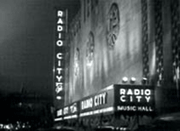 Radio City Music Hall—the largest cinema in the world with 6,200 seats—is opened by NBC in New York with a gala show. Over 100,000 people want to get in. Radio City Music Hall—the largest cinema in the world with 6,200 seats—is opened by NBC in New York with a gala show. Over 100,000 people want to get in. |
|
| December | EMI demonstrates an electronic scanning television system to the BBC. | |
| • | The ‘Academy’ film frame is standardised by the Society of Motion Picture Engineers (SMPTE) on the basis of discussions by the members of the Academy of Motion Picture Arts and Sciences (AMPAS). Designed to accommodate the optical soundtrack between the pictures and one set of perforations, the projection aperture has the ratio of 11:8 (1.375:1), slightly reduced in height from the original 4:3 (1.33:1) designed by Dickson in 1889. | |
| • | Film dubbing (voice replacement) starts to be used for different language versions, the technique having been four years in development. | < 1929 June 21 |
| • | All US production of foreign-language films and versions now ceases. | |
| • | The Emelka film studios in the Munich suburb of Gastelgasteig are taken over by newly formed Bavarian Film. | |
| • | A stereophonic sound film system is patented in France by Abel Gance and André Debrie. | |
| • | London Film Productions is founded by Alexander Korda. The previous autumn he arranged a contract with Paramount to make British films in order to allow Paramount to import American productions under the British film quota requirements. Company executives include Hungarian-born writer Lajos Biró, actor-writer George Grossmith, Conservative MP Captain A C N Dixie and Hungarian film director Steven Pallos. | |
| • | Sound City Film Producing & Recording Studios are opened by Norman London at Littleton Park, Shepperton; the 60-acre estate near London had been bought for £5,000 the previous year for that purpose. London had been a successful camera manufacturer and publisher of photographic flicker books under the name Flicker Productions. [0019] | |
| • | First attempts to develop an Indian colour film process fail. Keshavrao Dhaiber photographs Sairhandhari for his Prabhat Film Company, directed by V Shantaram (1901-1990) in Hindi and Marathi languages, but the negative is ruined in processing abroad; Madan Theatres’ production of Bilwamangal was no more successful. | |
| • | First film in Marathi language is Ayodhyecha Raja (The King of Ayodhya), one of three films directed by V Shantaram this year in bilingual Hindi and Marathi. | |
| • | Indian companies release 30 talkies during the year, eight of them produced by Madan Theatres, four directed by Jeejeebhoy Jamshedjii Madan—among them Indra Sabha (The Court of Lord Indra), the first Indian musical completely in verse form, featuring 71/72 songs. Madan company owned 126 theatres at this time, mainly not equipped for sound. | |
| • | Fox Film Corporation becomes major shareholder in Hoyts Australian cinema chain. | > 1982 |
| • | Taylor & Hobson in the UK introduce the [Cooke] Varo lens. Designed by Arthur Warmisham, using mechanical adjustments to achieve the zoom effect with a focal range of 40mm-120mm, it is manufactured by Bell & Howell in the US. | |
| • | 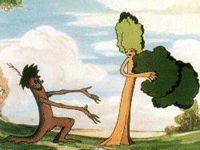 Walt Disney gains exclusive rights to the three-strip Technicolor for animation for the next three years, taking the opportunity to win two Academy Awards for short films: Flowers and Trees (1932, right) and The Three Little Pigs (1933). Walt Disney gains exclusive rights to the three-strip Technicolor for animation for the next three years, taking the opportunity to win two Academy Awards for short films: Flowers and Trees (1932, right) and The Three Little Pigs (1933). |
|
| • | Wilhelm Schneider at Agfa Filmfabrik in Wolfen, Germany patents a technique for incorporating colour dyes in gelatin layers to form a tripack colour film stock. This process is developed as Agfacolor. | |
| • | Warner Bros acquires the Stanley cinema chain in US. | |
| • | The British Board of Film Censors, responding to local licensing authority concerns about the growing number of horror films, introduces the H certificate. | > 1950 History of British film censorship |
| • | German Fritz Schröter, director of AEG, proposes the use of rotating heads across the width of magnetic tape for audio recording. This anticipates Ampex’s later rotating head system for video recording. | |
| • | Blaupunkt introduces the first car radio in Europe. | |
| • | BBC Research Department moves to 32 Nightingale Lane, Balham in south London. | > 1936 |
| • | Bell & Howell makes its first 16mm sound projector. | |
| • | A synthetic light polariser is invented by Edwin Land. | |
| • | Bush Radio is set up as a wireless receiver manufacturer in Shepherds Bush, London. | |
| • | German film production reaches 127 films. | |
| • | As the first Soviet Five Year Plan takes effect, the balance of film trade between the USA and USSR first shifts in favour of the Soviet industry. [0036] | > 1937 |
| • | Newly formed Compagnie Luxembourgeoise de Radiodiffusion (Radio Luxembourg) leases part of the Villa Louvigny in the centre of the city of Luxembourg as its headquarters and buys a site on the Juglinster plain for its transmitter. | > 1933 |
| • | Radio Rentals is formed in Brighton, England to rent radio sets to consumers unable to afford the full cost of a receiver. | > 1968 |
| • | The Baird company makes 76 television transmissions during the year. | |
| • | First Czechoslovakian talking picture in Slovak is The Singing Land, directed by Karel Plicka. | See also 1930 |
| • | Lord Beaverbrook buys out the stake of Daily Mail Trust in Daily Express newspaper. |
Page updated 8 January 2009
© David Fisher