






|
|
|
|
|
|
|
|
|
|
|
|
| 1936 |  Chronomedia index Chronomedia indexNumbers after entries link to the list of references. |
links and notes |
| Cultural highlights | Predictions made this year | ||
| January 1 | New York Herald Tribune is the first newspaper to begin microfilming its current issues. | |
| January 2 | Cathode ray tube capable of night vision is described at St Louis, Missouri. | |
| January 4 | Live television programming is shown on a screen 8ft x 6ft 6ins at the Dominion cinema in Tottenham Court Road, London from the Baird studio. | |
| January 4 | First pop music hit parade published by Billboard magazine in US, based on record sales in New York. First number one is Stop! Look! Listen! by Joe Venuti, the jazz violinist. | |
| January 15 | German television service re-opens on a daily basis, including live transmissions for the first time. | |
| January 31 | First episode of The Green Hornet is broadcast on WXYZ from Detroit, Michigan—the same station that produces The Lone Ranger. Indeed, the eponymous character (by name Britt Reid) is meant to be the great-nephew of John Reid, the Lone Ranger himself. The series is devised by George Washington Trendle and Fran Striker. | |
| January | Bell Laboratories experiments with coaxial cable. | |
| February 18 | Chaplin's film Modern Times is banned by the Propaganda Ministry in Germany. | |
| February | British and Dominion Film Corporation’s Imperial Studios at Elstree are gutted by fire. | |
| Fernseh demonstrates direct-projection large-screen television with a picture area of one square metre. | ||
| March 1 | First public videophone service is opened in Germany by non-Nazi Postminister Baron von Eltz-Rubenach at the start of the Leipzig Trade Fair. In Leipzig call booths are located at the fair ground and at the main post office in Augustplatz, in Berlin—160 km away—at Kolumbus Haus in Potsdamer Platz and at the corner of Hardenberg and Kantstrasse. The 180-line mechanical system uses equipment made by Fernseh at the Leipzig end and by the Post Office Laboratory in Berlin. It is available (to Aryans only) between 08:00 and 20:00 each day, a three-minute call on the service costing DM 3.50 (3s 6d=17½p). It continues after the fair closes on 7 March. | > May |
| March | General Cinema Finance Corporation (GCFC) is set up (by J Arthur Rank among others) with capital of £1,225,000 to acquire control of General Film Distributors; it also acquires a 25 per cent stake in Universal and has a seat on the board. | |
| March | UK’s Board of Trade appoints committee under Lord Moyne (former Minister for Agriculture and Fisheries) ‘to advise whether any, and if so what, measures are still required in the public interest to promote the production, renting and exhibition of [British] films’. | > November |
| March | Report of the Broadcasting Committee 1935 (Cmnd 5091), chaired by Lord Ullswater and including Lord Selsdon, presents its proposals for the future of British broadcasting after the expiry of the BBC's charter at the end of the year. Recommending extension of the charter for a further 10 years, it urges more regional autonomy and warns of the risks caused by broadcasts, including news, having an influence on political thought and processes. Its recommendation was accepted by government that, whilst the ban on advertising should continue, television could be partly funded by sponsorship. Another recommendation, that cultural aspects of broadcasting should be the responsibility of a cabinet minister, was rejected. | • Official British media reports |
| March | Germans begin installation of two-way television intercommunication stations in Hamburg, Berlin, Leipzig and Munich. Equipment, using mechanical scanning for transmission and cathode ray tubes for reception, was built largely by Fernseh in conjunction with the German Post Office. | |
| April | UK’s fledgling National Film Archive makes its first requests for prints of recent film releases for permanent preservation. | |
| May, early | Reich Postminister Dr Wilhelm Ohnesorge announces that the German public videophone service is to be extended from Berlin to Hamburg and Leipzig to Munich. The length of the network will be 1,000 km. | > 1937 |
| May 19 | BBC occupies newly fitted out Television Service studios at Alexandra Palace. | > August 12 |
| May | Denham Studios opens. Built for Alexander Korda’s London Film Productions, it is the largest studio in the UK, with seven sound stages, and full production facilities including a Technicolor laboratory and even a train service from central London. | |
| June 1 | Production of NBC Blue network's Lux Radio Theater moves from New York to Hollywood to attract movie stars. First broadcast from the new location is The Legionnaire and the Lady, starring Marlene Dietrich and Clark Gable. The following week: The Thin Man with William Powell and Myrna Loy. | |
| June 15 | Federal Communications Commission begins hearings on radio frequency allocations, to take the needs of future television services into account. The Radio Manufacturers Association recommends allocation of seven 6 MHz channels in the 42-90 MHz range, plus experimental channels at higher frequencies; these to be used for a 441-line system at 60 interlaced fields per second, giving 30 frames. | |
| June 29 | Experimental television transmissions of a 343-line system begin from the Empire State Building in New York. | |
| July 1 | Dutch broadcaster AVRO opens its studio at Hilversum. | |
| July 18 | CBS Radio launches its Columbia Workshop series of experimental radio dramas. | |
| July 24 | Post Office introduces a ‘speaking clock’ (dial TIM) in UK. | |
| August 1-16 | 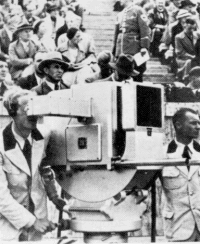 High-definition television broadcasts from the Berlin Olympic Games [right] are seen by 150,000 people in 28 public television rooms in Berlin. The Games are also filmed by Leni Riefenstahl (1902-2003) for the propagandistic Olympische Spiele feature-length production. Radio commentaries on events are also broadcast around
the world. High-definition television broadcasts from the Berlin Olympic Games [right] are seen by 150,000 people in 28 public television rooms in Berlin. The Games are also filmed by Leni Riefenstahl (1902-2003) for the propagandistic Olympische Spiele feature-length production. Radio commentaries on events are also broadcast around
the world. |
 Media at the Berlin Olympics |
| August 1 | Radio Luxembourg replaces the International Broadcasting Company (IBC) as its programme supplier with its own production subsidiary Wireless Publicity Ltd. During this year it acquires the whole of Villa Louvigny and launches an architectural competition for a new administrative block. | > 1939 |
| August 12 | First 10 transmissions of a chequerboard test pattern by BBC Television from Alexandra Palace. | > October 1 |
| August 26-September 5 | Experimental transmissions of high definition television are introduced for the Radiolympia Exhibition in London: Baird’s 240-line mechanical and EMI’s 405-line electronic systems are used on alternate days for two one-hour periods. |  BBC press release giving the schedule of transmissions |
| August 31 | .GIF) Elizabeth Cowell [right] becomes the first female television announcer during the BBC transmissions from Radiolympia. Elizabeth Cowell [right] becomes the first female television announcer during the BBC transmissions from Radiolympia. |
Click on picture for more |
| August | Demonstrations of television are given at the Sakhalin Colonisation Fair in Japan, using the Television Telephone System developed the previous year. | < 1935 |
| September 2 | The Cinémathèque Française is officially inaugurated, founded out of a film club, Le Cercle du Cinéma, that had been set up by Henri Langlois, Georges Franju and Jean Mitry. | |
| September 29 | First use of radio broadcasts for a US presidential campaign. | |
| September 30 | Pinewood Studios open near London. The studio is on the 156-acre Heatherden Hall estate at Iver Heath, Buckinghamshire, built by a new company formed by film producer-distributor J Arthur Rank and builder Charles Boot. Following a fire at British and Dominion Film Studios at Elstree, the latter company invests its insurance payout for a 50 per cent share in Pinewood. Many of the fittings in the mansion were taken from the liner Mauritania, bought by Charles Boot in 1936. [Heatherden Hall had been the location for the signing of the Irish Free State Treaty in 1929.] [0019] | |
| October 1 |  Regular television transmissions start by BBC from Alexandra Palace, north London. The television transmitter mast [right] at 'Ally Pally', so named by Gracie Fields, an early performer in the new medium, becomes a familiar on-screen icon for many years to come. Regular television transmissions start by BBC from Alexandra Palace, north London. The television transmitter mast [right] at 'Ally Pally', so named by Gracie Fields, an early performer in the new medium, becomes a familiar on-screen icon for many years to come. |
< August 12 > November 2 |
| October 5 | First television link between New York and Philadelphia makes us of a newly installed AT&T coaxial cable landline link. | < 1929 > 1937 |
| October 9 | BBC officially announces that the television service will begin on 2 November. | BBC press release making the announcement |
| October | Agfacolor reversal film for 35mm transparencies and 16mm cine introduced in Berlin. Marketing start in November. Film speed is 7 DIN (12 ASA). | |
| November 2 |  Official opening of first regular high-definition television service from BBC studios at Alexandra Palace, London. Alternating on a weekly basis between Baird's 240-line intermediate film system and Marconi-EMI's 405-line system all-electronic system. The 220 ft high mast in top of an 80-ft high east tower of the building, is over 600 ft above sea level to maximise radiation. Picture information is transmitted on an ultra-short wave frequency of 6.67m, sound on 7.23m. Two blocks of programmes are broadcast daily, Monday to Saturday, at 15:00-16:00 and 21:00-22:00. Official opening of first regular high-definition television service from BBC studios at Alexandra Palace, London. Alternating on a weekly basis between Baird's 240-line intermediate film system and Marconi-EMI's 405-line system all-electronic system. The 220 ft high mast in top of an 80-ft high east tower of the building, is over 600 ft above sea level to maximise radiation. Picture information is transmitted on an ultra-short wave frequency of 6.67m, sound on 7.23m. Two blocks of programmes are broadcast daily, Monday to Saturday, at 15:00-16:00 and 21:00-22:00. |
< October 1Pictures and text of the speeches made at the opening |
| November 2 | New Canadian Broadcasting Act comes into effect, creating the Canadian Broadcasting Corporation (CBC) to replace the Canadian Radio Broadcasting Commission, with broadly the same powers as the BBC. Although intended to provide full national coverage, a survey discovers that only 49 per cent of the Canadian population can hear CBC broadcasts. | |
| November | Moyne Committee report recommends that the government should watch to prevent the transfer of control of British film interests passing abroad. | |
| November | Philco Radio and Television Corporation completes field tests of a 345-line television system from its W3XE transmitter in Philadelphia and embarks on work towards a 441-line system, moving up from 1.5 MHz bandwidth requirement to 2.5 MHz. This is in line with the recommendations of the Radio Manufacturers Association to the FCC. | > 1937 |
| November 21 | First television gardening programme, In Your Garden with Mr Middleton, is broadcast by the BBC from a garden outside Alexandra Palace studios. | |
| November 28 | BBC Television transmits a mock-up of the Coronation ceremony for King Edward VIII, planned for next May, using a working model, 13 ft long and 3ft high, of the bands, soldiers, royal coach, etc, against a backdrop showing a 150-yard section of the crowds in Westminster. The model is built by two brothers, Edward and Frank Offord. | |
| November 30 | Fire destroys much of Baird television Company’s equipment at Crystal Palace. | |
| December 11 |  King Edward VIII makes his abdication speech on the wireless. King Edward VIII makes his abdication speech on the wireless. |
|
| December 17 | Ventriloquist Edgar Bergen, with his dummy Charlie McCarthy, makes his radio debut on The Rudy Vallee Show. | > 1937 |
| December | Michael Balcon leaves Gaumont-British to work for MGM on a more lucrative two-year contract. | |
| December 31 | BBC Charter expires and is renewed, following the predictable recommendation of the Ulleswater Committee. | |
| • | Spending by British firms on advertising on continental commercial radio stations during the year is £650,000.[0061] | < 1935 |
| • | Directors Guild of America is founded by 15 Hollywood directors, with King Vidor as president. Members are Frank Borzage, John Cromwell, Howard Hawks, William K Howard, Gregory LaCava, Rowland V Lee, Leo McCarey, Rouben Mamoulian, Lewis Milestone, Wesley Ruggles, Eddie Sutherland, Frank Tuttle, Richard Wallace and William Wellman. | |
| • | Pennine Film Studio is founded in a disused cotton shuttle-making factory at Blackburn, England to make talkies with a Lancashire flavour. It survives until the outbreak of war in 1939. | |
| • | Technique for depositing magnesium fluoride in an ultra-thin film on lens surfaces in a vacuum is devised in the US by John Strong. | See also 1935 |
| • | Gaumont-British makes an arrangement with Twentieth Century-Fox to rescue it from financial collapse. Rival BIP had been negotiating a deal with Gaumont-British but lost a subsequent court case over being excluded from the deal. | |
| • | Criterion Film Productions acquires Worton Hall Studios at Isleworth, west London. [0019] | |
| • | Fox-British Studios buys Wembley Studios, which is has been leasing since 1934. [0019] | |
| • | Associated British Cinemas acquires 130 more cinemas. | |
| • | French films achieve a 50 per cent share of domestic box office for the first time since 1918. [0036] | |
| • | German government forms a company to acquire existing film companies. [0036] | |
| • | The first feature film produced by Greenland is a Danish co-production, The Wedding of Palo, directed by Knud Rasmussen and Friedrich Dalsheim. | |
| • | BBC’s first and only pre-war film documentary, Television Comes to London, is transmitted. | |
| • | BBC Research Department moves to Nightingale Square, Balham in south London. | > 1949 |
| • | Walt Disney approaches BBC with offer of two Mickey Mouse cartoons each day for transmission. It is first film company to supply films to British television. | |
| • | Scophony is incorporated in the UK as a limited company. | |
| • |  Bell & Howell introduces Model 134 double-8mm cinema camera, replacing Model 127 of the previous year. Bell & Howell introduces Model 134 double-8mm cinema camera, replacing Model 127 of the previous year. |
|
| • | Irish Film Society is founded in Dublin. | |
| • | Canadian wireless receiving licence fee is established at C$2.00. | |
| • | Indian Broadcasting Service is renamed All-India Radio. | |
| • | Radio service starts in Iraq. | |
| • | Public demonstrations of RCA-NBC high-definition electronic television system with live action and filmed inserts (Felix the Cat cartoons). RCA demonstrates a prototype receiver to the Radio Manufacturers Association and instals 150 receivers in homes in the New York area. | |
| • | Arthur C Nielsen Snr buys the rights in a device that can detect and log the frequency to which a radio receiver is tuned, after seeing it demonstrated during a lecture at the Massachusetts Institute of Technology. Calling it the audiometer, he uses it to establish a radio programme ratings service, The Nielsen Radio Index, based on an 800-home sample. | |
| • | A French invention, the signaphone, combines a fire detector or burglar alarm with a device that stores the police or fire brigade telephone number as projections on small metal discs to initiate a telephone call before replaying a message stored on a gramphone disc. The same message can then be replayed to another recipient, such as the owner of business premises at home. | |
| • |  Seeing the success of Eclipse records in Woolworths' UK stores, which have also been selling well in Canada, the American parent company introduces a new label, Crown, that will be a common brand in its stores on both sides of the Atlantic, including Germany. Successful titles are shipped between markets, 20-34 titles a month being issued. The price in the UK continues to be 6d (2½p), compared with the 1s 3d (7p) charged for HMV and Decca records. Seeing the success of Eclipse records in Woolworths' UK stores, which have also been selling well in Canada, the American parent company introduces a new label, Crown, that will be a common brand in its stores on both sides of the Atlantic, including Germany. Successful titles are shipped between markets, 20-34 titles a month being issued. The price in the UK continues to be 6d (2½p), compared with the 1s 3d (7p) charged for HMV and Decca records.[Image: Woolworths Virtual Museum] |
> 1954 |
Page updated 19 February 2009
© David Fisher