| 1939 |
 Chronomedia index Chronomedia index
Numbers after entries link to the list of references. |
links and notes |
| |
Cultural highlights | Predictions made this year |
|
| January |
Direct projection television with a 15ft x 12ft screen is installed at the1,190-seat Marble Arch Pavilion cienma in London by the Baird Company. |
|
| January |
German Post Office Television Cinema begins continuous operation. |
|
| February 1 |
Television broadcasting is started by Ukrainian Radio in Kiev. |
> 1941 July 22 |
| March 5 |
BBC begins European Service broadcasts in Hungarian. |
|
| March |
 Lale Andersen (born Lieselotte Helene Berta Bunnenberg, 1905-1972) records Lied eines Jungen Wachtpostens (Song of a Young Sentry) for the German Electrola label. It becomes famous and popular with both German and Allied armies as Lili Marleen/Lily Marlene when used as the closedown song by Soldatensender Beograd (German Soldiers’ Network Belgrade) in 1940 and translated into English in 1941. Lale Andersen (born Lieselotte Helene Berta Bunnenberg, 1905-1972) records Lied eines Jungen Wachtpostens (Song of a Young Sentry) for the German Electrola label. It becomes famous and popular with both German and Allied armies as Lili Marleen/Lily Marlene when used as the closedown song by Soldatensender Beograd (German Soldiers’ Network Belgrade) in 1940 and translated into English in 1941. |
|
| April 4 |
Glenn Miller Orchestra records Moonlight Serenade. |
|
| April 12 |
Woody Herman Orchestra records At the Woodchoppers Ball. |
|
| April |
Allan B DuMont Laboratories starts to market television receivers in US—the first company to do so. Fortune magazine reports that Paramount Pictures has an arrangement to buy shares in the company to fund television research, the first Hollywood major (or film interest of any kind) to make a move into television. |
> 1948 December |
| April 30 |
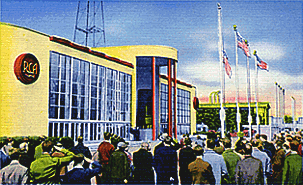 NBC launches a regular public television service with the formal opening of the New York World's Fair by President Franklin Roosevelt (the first of only two appearances he makes on television). Two hours of programmes a week, to be received on RCA sets, are intended 'to make the art of television available to the public'. NBC launches a regular public television service with the formal opening of the New York World's Fair by President Franklin Roosevelt (the first of only two appearances he makes on television). Two hours of programmes a week, to be received on RCA sets, are intended 'to make the art of television available to the public'. |
Click on main picture for RCA pavilion at the World's Fair
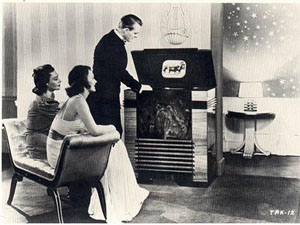 RCA television receivers in 1939 RCA television receivers in 1939
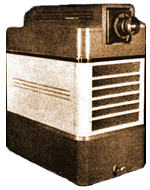 RCA projection television at the World's Fair RCA projection television at the World's Fair |
| • |
Only known performance of Vitarama—forerunner of Cinerama—is given in the Petroleum Industry exhibit at the New York World’s Fair.
Also on show, on the Western Electric stand, is the Voder, a system for synthesising speech by means of a keyboard, developed by a team under Stanley Watkins.
Hans Laube demonstrates his Scentovision invention for piping odours into a cinema auditorium, under the control of the projectionist. [This later becomes
Smell-o-Vision.] |
|
| May 1 |
The musical comedy Me and My Girl is televised live in its entirety from the Victoria Palace theatre in London by the BBC. The show, directed by Lupino Lane, written by Douglas Furber and L Arthur Rose with music by Noel Gay, includes The Lambeth Walk, phenomenally successful number, the popularity of which sweeps across Europe—especially in Germany, where it is called Lamberts Nachtlokal. |
So successful was The Lambeth Walk that it was widely thought to be part of traditional Cockney culture [0082] |
| May 2 |
National Film Board of Canada is formed on the basis of a report by John Grierson. |
|
| May 14 |
BBC begins Overseas Service broadcasts in Afrikaans. |
|
| May 17 |
 First televised baseball game is between Princeton and Columbia universities at Baker's Field, New York [right]. First televised baseball game is between Princeton and Columbia universities at Baker's Field, New York [right]. |
|
| May |
International Standards Association conference held at Broadcasting House, London establishes frequency of A in the treble clef ('concert pitch') at 440Hz, having previously varied between 435Hz and 442Hz. |
|
| May |
First FM radio station in the USA, W43B, goes on air. |
|
| May |
Successful experimental television transmission is carried out by NHK Technical Research Laboratories in Japan. A programme of transmissions begins. |
> 1941 |
| • |
Rank Organisation buys the Amalgamated Studios at Elstree, on the mortgage for which building firm McAlpine had recently foreclosed, having failed to come on line in 1937. |
|
| summer |
Wer fuhr IIA 2992?, a 15-minute thriller film drama, is specially made for television by Ufa studios in Germany. |
A copy of the film is held in the Bundesarchiv-Filmarchiv Koblenz |
| June 1 |
Heavyweight boxing match between Max Baer and Lou Nova is the first to be televised in the USA. |
|
| June 4 |
BBC launches a radio service to Spain and Portugal. |
|
| June 6 |
US patent is granted to Rolf Möller of Fernseh AG for the continuous film recording system using a cathode ray tube. |
|
| June 7 |
Harley Iams and Albert Rose of RCA introduce the Orthicon television camera tube. Its conformation allows the use of a simple cylindrical tube four to five inches in diameter. The electron scanning beam is focused by means of a magnetic coil surrounding the tube. |
|
| June 18 |
Radio Normandie's schedule for this day (a Sunday) is in the Media: Radio section. |
|
| July 13 |
Frank Sinatra makes his first recording, Melancholy Mood with the Henry James Orchestra. |
|
| July 28 |
Judy Garland records Over the Rainbow for Decca Records. |
|
| July |
RCA starts experimental all-electronic television broadcasting from the Empire State Building, New York on 343-line standard. |
|
| August 24 |
 BBC Monitoring Service is established at Wood Norton in Surrey [left]. BBC Monitoring Service is established at Wood Norton in Surrey [left]. |
|
| August 26 |
First major league baseball games are televised by W2XBS from Ebetts Field, New York: a double-header between the Brooklyn Dodgers and the Cincinnati Reds. |
|
| September 1 |
All BBC studios and transmitters are converted in the early hours to wartime conditions; this includes arranging two synchronised groups of radio transmitters to prevent location finding, and creation of the ‘Home Service’ on radio (at 08:15). BBC Television Service, with continuity links from the Radio Exhibition at Olympia, closes at 12:10, ending unceremoniously with a Mickey Mouse cartoon, Mickey’s Gala Première, in which the last words are a Garbo caricature saying ‘Ah tink ah go home’. (The order to close the service had not been received at Alexandra Palace at noon.) In the eight months of the year to date television transmitters have operated for an aggregate of 2,403 hours (cf, 1938) and had an audience of around 20,000-25,000 households. |
|
| September 1 |
A law on 'Receiving of Wireless Transmissions' is promulgated in Germany. It bans listening to any radio station not under German control, including Italian stations, and covers all forms of transmission, including music. |
|
| September 1-20 |
 First Cannes Film Festival is due to take place as a less politicised rival to the Mostra in Venice but another (even more politicised) event starts instead and only the opening evening takes place. The French government had agreed to underwrite costs, selecting Cannes in preference to Biarritz. Also promised is a Palais des Festivals, which finally opens in 1949. First Cannes Film Festival is due to take place as a less politicised rival to the Mostra in Venice but another (even more politicised) event starts instead and only the opening evening takes place. The French government had agreed to underwrite costs, selecting Cannes in preference to Biarritz. Also promised is a Palais des Festivals, which finally opens in 1949. |
|
| September 3, 11:15 |
Declaration of war is broadcast on the BBC by prime minister Neville Chamberlain. His speech, broadcast live, is recorded on disc at the BBC's Maida Vale premises and on a Blattnerphone steel tape recorder at the BBC's Research Department at Wood Norton. |
|
| September 3 |
Cinemas are closed throughout the country to prevent concentrations of people being caught in air-raids, which never materialise. Except for those in the centre of London, cinemas re-open within the next two weeks. As a result, UK cinema admissions dip by 30 per cent during the first month of war but by November are already above average and continue to grow to record levels by 1946. |
 Places of entertainment to be closed Places of entertainment to be closed |
| • |
In UK, Beaconsfield Studios and Walton-on-Thames Studio are requisitioned by the Ministry of Works, Beaconsfield for use by Rotax as an aircraft engine magneto factory, Walton-on-Thames for aircraft production by Vickers-Armstrong (Spitfire fighters and Wellington bombers), following a direct hit on the Vickers plant. Shepperton Studios is used to make decoy scenery and dummy aircraft. Bushey Film Studios is used as an ARP (Air Raid Precautions) depot and to store nitrate films away from danger in London. BIP Studios (now Associated British Picture Corporation, ABPC) at Elstree are requisitioned by the Royal Ordnance Corps. Amalgamated Studios are used by the Ministry of Works for storage. MP Studios at Elstree and Worton Hall Studios at Isleworth are requisitioned. Pinewood Studios provides accommodation for Lloyds of London, the Royal Mint and the Crown and Royal Air Force film units. Teddington Studios are closed. During the war Twickenham and Teddington Studios receive direct hits.
[0019] |
|
| September 7 |
BBC begins European Service broadcasts in Polish. |
|
| September 8 |
BBC begins European Service broadcasts in Czech. |
|
| September 11 |
Cinemas in the UK outside the urban areas are allowed to re-open. |
|
| September 15 |
BBC begins European Service broadcasts in Romanian, Serbo-Croat and Slovene. |
|
| September 15 |
Cinemas in UK urban areas are allowed to re-open but must close by 22:00, except in the West End of London, where closing time is 18:00. |
|
| September 21 |
Radio Luxembourg ceases English-language transmissions. By now its headquarters complex is complete with two large and four small studios and support facilities. |
> 1946 |
| September 30 |
BBC begins European Service broadcasts in Greek. |
|
| September 30 |
First American football college game is televised by W2XBS from the Triboro Stadium. Fordham University beat Waynesburg College. |
|
| September |
BBC publishes Broadcasting in Everyday Life by Hilda Jennings and Winifrid Gill, the report of a survey by Bristol University Settlement of the impact of broadcasting, the first attempt at a long-term study of effects. |
|
| September |
Three more London Gaumont-British theatres have been equipped with Baird large-screen television systems; plans for a further seven are curtailed by war. |
Cinema-television |
| September |
Radio International is set up by the International Broadcasting Company (IBC) to broadcast English-language entertainment to forces in continental Europe, using Radio Normandy's facilities. Billed as 'The station behind the lines', it is on the air daily at 07:00 to 18:00, broadcasting mainly recorded (and record) programmes with the sponsors' messages removed. |
> 1940 |
| September |
At the month end there are 9,082,666 wireless receiving licences in force in the UK, representing 73 per cent of households; only Denmark and Sweden have higher penetration in Europe, US and New Zealand elsewhere. |
|
| October 4 |
Cinemas in London's West End can stay open until 22:00 but a weekly rota is applied to reduce risk. |
|
| October 14 |
Broadcast Music Incorporated (BMI) is formed in the USA as a collection agency for royalties. |
|
| October 22 |
Station W2XBS broadcasts the first televised professional American football game in the US: Brooklyn v Philadelphia. |
|
| October 30 |
BBC begins broadcasts in Indonesian. |
|
| November 4 |
All UK cinemas can remain open until 23:00. |
|
| November 6 |
General Electric's television station WRGB begins regular transmissions. It is equipped with three GE cameras with iconoscope tubes, two with 170mm lenses and one with a 250mm lens for close-ups. |
|
| November 8 |
RCA announces preparations for simultaneous transmission of NBC television programmes from the Empire State Building in New York and from Schenectady; the BBC had been making similar relay plans when the television service was closed on 1 September. |
|
| November 20 |
BBC begins broadcasts in Turkish. |
|
| November 30 |
BBC radio transmitters operate for total of 75,636 hours during the year (0.021 per cent loss through breakdowns) on domestic programmes. The Overseas Service transmits 43,198 hours in 14 languages. |
|
| December 4, 07:35 |
BBC broadcasts the first physical jerks (aka 'daily dozen') programme for wartime fitness, on alternating days for men and women; the audience at the year end is estimated at 750,000 men and 900,000 women. |
|
| December 20 |
Radio Australia begins short-wave overseas broadcasting. |
|
| December |
RCA is now transmitting television on a 441-line standard in the US. |
cf July |
| December |
According to BBC research, 27 per cent of the British population regularly listens to broadcasts from Hamburg by William Joyce (Lord Haw-Haw). |
> 1945 |
| end |
German distributors have a monopoly in 8,300 cinemas—twice the number in Germany itself. [0036] |
|
| • |
In the 12 years since 1927 the US has imported 2,393 feature films, of which 428 are British. |
|
| • |
By now, 16 companies have either started or intend to start manufacturing television sets in the US, not all on the same line standard. |
|
| • |
The negative cost of The Wizard of Oz—made in three-strip Technicolor, with the Kansas scenes using MGM's proprietary Sepia Platinum monochrome effect—is $2.777m, making it the second most expensive production ever. |
< 1930 |
| • |
 Orson Welles, already a theatre and radio star at the age of 24, is signed as a producer/director/actor by RKO Pictures. He receives a $150,000 advance and 25 per cent of the gross distribution receipts on each film he makes. Orson Welles, already a theatre and radio star at the age of 24, is signed as a producer/director/actor by RKO Pictures. He receives a $150,000 advance and 25 per cent of the gross distribution receipts on each film he makes. |
> 1941 |
| • |
By the year end Baird Television Ltd goes into liquidation and is re-formed as Cinema-Television, without J L Baird on the board. |
|
| • |
Dr Fritz Fischer of the Swiss Federal Institute of Technology conceives an idea for a projection television system, which becomes Eidophor, and applies for a patent. |
> 1943 |
| • |
Screen Actors Guild in Hollywood imposes a ruling that artists' agents cannot also act as producers, although waivers are often allowed. |
|
| • |
Mills Novelty Company of Chicago, Illinois begins production and marketing of its Panoram visual jukebox. The machines have a 27-inch screen onto which 16mm film loops, with a maximum running time of 3½ minutes, are projected via a series of mirrors within the cabinet. Over the next six years hundreds of 'soundies' short films are released. |
|
| • |
Academy of Motion Picture Arts and Sciences officially adopts the nickname 'Oscars' for its Academy Awards. |
< 1929 |
| • |
Edwin H Armstrong builds a frequency modulation (FM) transmitting station at Alpine, NJ. |
> 1940 |
| • |
English-language farm broadcasts begin in Canada. |
|
| • |
New lens coatings allow 75 per cent more light to reach the film in cinematograph cameras, allowing an extra stop in lens aperture and thus improving image definition. |
|
| • |
Hollywood's film industry employs 177,420 people, of whom 33,687 are engaged directly in production. Total production expenditure is $187m and the major studios produce 388 films. |
|
| • |
Of 638 films registered in UK, 103 (16 per cent) are British. |
|
| • |
First talkie made in Colombia is Flowers of the Valley, directed by Pedro Moreno Garzón. |
|
| • |
Experimental electronic television developments by Eiar, precursor of Radiotelevisione Italiana (RAI) in Rome. |
|
| • |
Finland is planning a television service in time to broadcast the 1940 Olympic Games (XII Olympiad). |
|
| • |
Intercollegiate Broadcasting System is founded in the US. |
|
| • |
Coaxial cable is developed with improved insulation and first manufactured by Imperial Chemical Industries (ICI) in the UK. The use of sheathing made of polythene (polymerised ethylene)—being produced commercially by ICI for the first time—for the core cable greatly improves electrical insulation. |
< 1937
> 1940 |