






|
|
|
|
|
|
|
|
|
|
|
|
| 1945 |  Chronomedia index Chronomedia indexNumbers after entries link to the list of references. |
links and notes |
| Cultural highlights | Predictions made this year | ||
| February 25 | Canadian Broadcasting Corporation's International Service officially opens. | |
| February 26 | Midnight curfew is introduced for all places of entertainment in the USA. | > May 6 |
| March 7 | The Academy Awards ceremony is first broadcast on nationwide radio in the US. | |
| March | Hankey Committee recommends temporary revival of a 405-line television service in the UK but advocates exploration of 1,000-line technology suitable for cinemas and of colour and 3-D, to replace 405-line monochrome as soon as possible. | British media reports |
| March | Around 10,500 set decorator members of the Conference of Studio Unions (CSU) go on strike in Hollywood, the outcome of a period of inter-union rivalry between the CSU and IATSE, the International Alliance of Theatrical Stage Employes (sic), and protracted prevarication by studios over negotiations. The strike lasts for 30 weeks. | > October 5 |
| May 1 | Radio Budapest in Hungary resumes short-wave radio broadcasts. | |
| May 3 | Last transmissions from Reichssender Hamburg. It becomes Radio Hamburg under the control of British forces of occupation. | |
| May 6 | Midnight curfew is lifted for all places of entertainment in the USA. | |
| May 8 | On VE Day WNBT television in New York is on the air from 08:45 am to 23:00 with live coverage of celebrations. WRGB in Schenectady, NY carried the WNBT feed throughout the day interspersed with its own local coverage from a mobile unit. | |
| May 13 | Radio transmissions begin again in East Berlin under Soviet military control from the former Nazi broadcasting centre (Haus des Rundfunks) in Masurenallee under the identity 'Hier spricht Berlin' (Berlin Calling!). | |
| June 11 | Seven US radio commentators are put under investigation by the House Un-American Activities Committee (HUAC). | |
| June 18 |  Lord Haw-Haw (William Joyce) is arrested and charged with treason for making pro-Nazi broadcasts to Britain during the war. He is retained in Hamburg while the English law on treason is amended to allow prosecution of persons of Irish descent, Joyce having been born in New York of Irish parentage before the creation of the Irish Free State. Lord Haw-Haw (William Joyce) is arrested and charged with treason for making pro-Nazi broadcasts to Britain during the war. He is retained in Hamburg while the English law on treason is amended to allow prosecution of persons of Irish descent, Joyce having been born in New York of Irish parentage before the creation of the Irish Free State. |
|
| July 11 05:30 | First test explosion of an atomic bomb in New Mexico, USA. Cost of research to date is put at £500m, which has included employing 125,000 people. | |
| July 28 | Last broadcast of the AEF Programme. | |
| July 29 | BBC Light Programme is introduced on the Forces' Programme frequencies of 261.1m MW and 1500m LW. It adopts Oranges and Lemons as its signature tune from the AEF Programme. Regional broadcasting also resumes. | |
| August 6 | Enola Gay drops the first atomic bomb on Hiroshima, Japan. | |
| c August 15 | Westinghouse Electric Corporation proposes Stratovision, a system of television tranmission using aircraft to relay signals across the US. To be developed with the Glenn L Martin aviation company, a transmitter in a plane at 30,000 feet could cover a radius of 211 miles; the system would require 14 aeroplanes to be in the air at any time to cover 78 per cent of the US area at a cost of $1,000 an hour for each plane. | > 1946 |
| autumn | 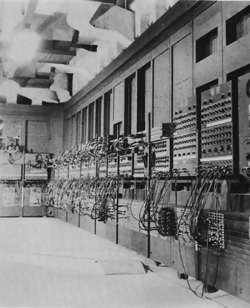 Eniac(Electronic Numerical Integrator And Calculator) electronic computer [right] is assembled in the Moore School of Electrical Engineering at the University of Pennsylvania, Philadelphia, by Professor J G Brainerd, J P Eckert and Dr J W Mauchly. Its 30 separate component modules incorporate 18,000 vacuum tubes, weigh over 30 tons and consume nearly 200kW of electric power. By 1946 it costs $487,000. It can count from one to 5,000 in one second. [Intel's first chip processor measures 12mm x 12mm, has 12 times the computing power of Eniac and costs $200. Current processor technology (2007) is approximately 2m times more powerful still.] Eniac(Electronic Numerical Integrator And Calculator) electronic computer [right] is assembled in the Moore School of Electrical Engineering at the University of Pennsylvania, Philadelphia, by Professor J G Brainerd, J P Eckert and Dr J W Mauchly. Its 30 separate component modules incorporate 18,000 vacuum tubes, weigh over 30 tons and consume nearly 200kW of electric power. By 1946 it costs $487,000. It can count from one to 5,000 in one second. [Intel's first chip processor measures 12mm x 12mm, has 12 times the computing power of Eniac and costs $200. Current processor technology (2007) is approximately 2m times more powerful still.] |
> 1946 |
| October 5 | 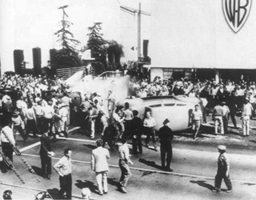 Strike by members of the Conference of Studio Unions (CSU) in Hollywood erupts into violence and confrontation outside Warner Bros studio between picketing strikers, Warner security guards and police. The event becomes known as Hollywood Black Friday and begins a week of sporadic violence. The strike ends within a month but is used to escalate claims about communist infiltration in Hollywood. Strike by members of the Conference of Studio Unions (CSU) in Hollywood erupts into violence and confrontation outside Warner Bros studio between picketing strikers, Warner security guards and police. The event becomes known as Hollywood Black Friday and begins a week of sporadic violence. The strike ends within a month but is used to escalate claims about communist infiltration in Hollywood. |
The 'red menace' in Hollywood |
| October 10 | French 441-line television system is revived by Radiodiffusion Française from the transmitter at the Eiffel Tower on a modest basis. | |
| October 25 | 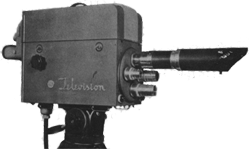 RCA brings image orthicon television cameras into use at its studios in Radio City, New York. For the first time, television camera tubes are more sensitive to light than the prevailing film emulsions. RCA brings image orthicon television cameras into use at its studios in Radio City, New York. For the first time, television camera tubes are more sensitive to light than the prevailing film emulsions. |
|
| October 29 | Ball-point pens, using the design invented but not patented in the US by Laszlo Biró, go on sale at Gimbel's store in New York. A consumer version is introduced in time for Christmas in the UK by the Miles-Martin Pen Company. | |
| October | Wartime US ban on opening new television stations and manufacturing receivers is lifted. Nine stations are on air and an estimated 7,000 TV sets are still in working order. | Start dates of US television stations. |
| October | Large demonstration of television is held at Gimbel's Department Store in Philadelphia, attracting over 25,000 people in three weeks to watch NBC from New York and local programming from Philco's KYW Philadelphia station. | |
| October | Mitteldeutsche Rundfunk (Central German Radio) goes on air from Leipzig in the Soviet-controlled zone of East Germany. | |
| November 27 | UK government appoints a new Television Advisory Committee, chaired by G M Garro-Jones. | |
| December 15 | Regular television broadcasting begins in Moscow. | |
| December 17 | French television broadcasts its first weather report. | |
| • | Former NBC Blue network becomes ABC when owner Edward Noble buys the name American Broadcasting Company from George Storer. Because of wartime restrictions the network has not been able to build its own studios. Its television programmes originate from the DuMont and General Electric studios. | |
| • | Warner Bros increases its stake in Associated British Picture Corporation to 37½ per cent. | |
| • | Warner Bros temporarily withdraws from membership of the MPPDA. | |
| • | MPPDA changes its name to Motion Picture Association of America (MPAA) soon after the retirement of Will Hays. The Motion Picture Export Association of America (MPEAA) is formed. | |
| • | Sir Alexander Korda buys back London Film Productions from MGM and also gains control of British Lion. | |
| • | Islington Studios in north London re-opens for production. It is now owned by the Rank Organisation, which acquired the studio during the war. Rank Organisation also acquires Highbury Studios in north London. | |
| • | Finnish Film Producers’ Association is formed. | |
| • | The British Federation of Film Societies is founded. | |
| • | Screen Extras Guild is established. | |
| • | Only eight per cent of Hollywood feature films are in colour (all Technicolor). | > 1950 |
| • | Drive-in cinema building boom begins in the US after the Supreme Court overturns Hollingshead’s patent. At the year-end there are 24 in the country | > 1956 |
| • | Australian National Film Board is established as a branch of the federal government, modelled on the National Film Board of Canada, following a report by John Grierson. The ANFB is renamed the Commonwealth Film Unit in 1956, Film Australia in 1973. | |
| • | Olivia de Havilland successfully sues Warner Brothers to prevent periods of ‘suspension’ (for refusing inferior roles) being added to contracts. Hereafter seven-year contracts run for seven years only. | |
| • | French ban on Jean Vigo's 1933 film Zéro de Conduite, imposed because of its anarchistic approach to school, is lifted. | |
| • | Televised events in the US include the Navy Day celebration in Central Park, New York, featuring President Harry S Truman. | |
| • | By the end of the Second World War, RCA has invested $10m in the development of television. | |
| • | CBS sets up a Television Audience Research Institute to promote the medium for advertising, including help for advertisers to devise and test new techniques. | |
| • | Among US national television advertisers: Botany Worsted Mills, Bulova Watches, Esso, Firestone Tire & Rubber, Gillette, Pan American World Airways, RCA Victor (all on NBC's WNBT, New York), Lever Bros (on CBS's WCBW, New York), US Rubber, Macy & Co and Alexander Smith & Sons (on DuMont's WABD, New York). | |
| • | US radio advertising sales for the year total $310.45m, a gain of 7.3 per cent over 1944. NBC's gross income for the year is up7.5 per cent at $61.27m. | |
| • | Baird sets up John Logie Baird Ltd, with premises at 4 Upper Grosvenor Street, London. | |
| • | First Commonwealth Broadcasting Conference is held in London. | |
| • | BBC establishes a short-lived broadcasting service to Welsh speakers in Patagonia. It closes the following year. | |
| • | Several AEG Magnetophone tape recorders are taken back from Germany to America by US military as reparations. | |
| • | Decca Record Company adopts 'ffrr' (full frequency range recording) as a trademark. | |
| • | UK publisher of Financial News buys the Financial Times and merges them under the latter title. |
Page updated 15 June 2009
© David Fisher