| 1953 |
 Chronomedia index Chronomedia index
Numbers after entries link to the list of references. |
links and notes |
| |
Cultural highlights | Predictions made this year |
|
| January 15 |
On leaving office President Harry S Truman makes his farewell speech on radio and television. |
|
| January 19 |
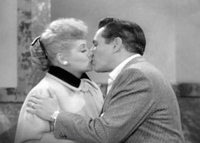 Episode of comedy series I Love Lucy in which she gives birth achieves a 68 per cent rating. The show's star, Lucille Ball, happens to give birth on the day the filmed episode is screened, becoming bigger news next day for many than the inauguration of President Dwight D Eisenhower. Episode of comedy series I Love Lucy in which she gives birth achieves a 68 per cent rating. The show's star, Lucille Ball, happens to give birth on the day the filmed episode is screened, becoming bigger news next day for many than the inauguration of President Dwight D Eisenhower. |
< February 18 |
| January 20 |
Television signals are broadcast across the border into Canada from Buffalo, NY. |
|
| January 30 |
First television test transmission in Norway. |
> 1954 |
| February 2 |
Twentieth Century-Fox president Spyros P Skouras and Darryl F Zanuck, head of production, announce that all future films will be made in CinemaScope. A few days earlier Zanuck already selected Lloyd C Douglas's production of The Robe to be the first CinemaScope production. The aspect ratio is set at 2.66:1. |
|
| February 11 |
United Paramount Theaters takes over American Broadcasting Companies (ABC) for $25m, two days after receiving FCC clearance on the basis that UPT genuinely intends to develop a competitive television service and not just protect its cinema operations. ABC's network consists of five owned and operated (o&o) stations and nine affiliates. Its ratings lag behind the other three networks. |
|
| February 13 |
Pioneering 3D movie Bwana Devil ('A lion in your lap, a lover in your arms'), produced by Arch Oboler, opens in New York. |
> April 10
 Oboler quotations Oboler quotations
 Spate of 3-D movies lacks depth Spate of 3-D movies lacks depth |
| February 18 |
Desilu signs a record $8m three-season contract to continue producing I Love Lucy for CBS. |
< January 19 |
| February |
 NHK’s Tokyo Television Station inaugurates regular television broadcasts in Japan [right]. NHK’s Tokyo Television Station inaugurates regular television broadcasts in Japan [right]. |
|
| February |
BBC is given permission to erect temporary transmitters to bring television signals to Balfast, Brighton and Newcastle in time for the Coronation coverage. |
'Temporary' is relative: the Brighton transmitter continues until 1957 |
| late February/early March |
Package of British short 3D films from Stereo-Techniques Ltd is released in the US by Sol Lesser to sustain audience interest while features are produced to follow Bwana Devil. Stereo-Techniques' sales director, Kenneth A Nyman (himself an exhibitor), tells an audience at Oxford University that the company has agreements with Ealing Studios and Sir Alexander Korda to use the technology. |
|
| March 12 |
First television broadcast in Hawaii. |
|
| March 18 |
MGM, which has been working on its own wide-screen system, becomes the first studio to adopt CinemaScope. So as to create an industry standard and justify exhibitors' commitment of investment in equipment, other major studios agree to adopt the Fox system as standard. Warner Bros will join later in the year after the release of The Robe but Paramount prefers to back developments in 3D. |
|
| March 19 |
First television coverage of the Academy Awards ceremony. Walt Disney wins four awards—the most ever taken by an individual in a single year—for documentary feature, documentary short subject, cartoon short subject and two-reel short subject. He wins 26 Oscars during his career. Bob Hope comperes in Hollywood, Frederic March presents awards in New York. |
|
| March 25 |
CBS tells a Congressional hearing that it does not intend to revive its sequential colour television system. |
|
| March 26 |
US ban on colour television receiver production is revoked by the National Production Authority. |
|
| March 27 |
First record releases by Sun Records of Memphis, Tennessee. |
|
| March |
The Association of Independent Cinemas (AIC) is formed in the UK to represent the interests of exhibitors other than the main circuits. |
|
| April 3 |
 Having acquired the Chicago-based TV Forecast and similar listings publications in New York, Philadelphia and Washington, Walter Annenberg re-launches them as TV Guide. The first national issue [right] features Lucille Ball's baby on the front cover. Having acquired the Chicago-based TV Forecast and similar listings publications in New York, Philadelphia and Washington, Walter Annenberg re-launches them as TV Guide. The first national issue [right] features Lucille Ball's baby on the front cover. |
|
| April 10 |
 New York premiere of Warner Bros’ House of Wax, the first 3-D film with stereo sound for dialogue. New York premiere of Warner Bros’ House of Wax, the first 3-D film with stereo sound for dialogue. |
Spate of 3-D movies lacks depth |
| April 14 |
Twentieth Century-Fox signs an exclusive contract with optical manufacturer Bausch & Lomb to produce anamorphic lenses for CinemaScope. CinemaScope presentations carry the credit ‘lenses by Bausch and Lomb’, the original Chrétien lenses that Fox acquired having proved to have shortcomings, not the least of which is the requirement to focus both the primary lens and the add-on anamorphic lens separately. |
|
| April 14 |
In his Budget speech, British Chancellor of the Exchequer R A Butler reduces purchase (sales) tax on consumer goods such as radio and television receivers from 66.67 per cent to 50 per cent. |
> June 22 |
| April |
Television: The Viewer and the Advertiser is published by the UK advertising industry, outlining for the first time a competitive commercial system. |
|
| May 11 |
Twentieth Century-Fox reduces the aspect ratio of CinemaScope from 2.66:1 to 2.55:1 and the sprocket holes (nicknamed 'Fox holes') are slightly smaller than the conventional Bell & Howell perforations to allow for four magnetic-stripe sound tracks (left, right, centre and surround). Exhibitors accept the need for new lenses, costing $2,875 a pair, but not for re-equipping for multi-track audio. |
|
| May 25 |
A non-commercial (‘educational’) US television station begins transmissions in Houston, Texas, using a channel reserved by the FCC for the purpose. |
> 1957 |
| May 28 |
Premiere of Melody, the first Technicolor 3-D animated film. |
|
| June 2 10:15-18:00 |
 BBC Television coverage of Queen Elizabeth II’s coronation achieves a UK peak viewing audience of over 20m, overtaking the radio audience (12m) for the first time. A total of 21 cameras are used for the event. The programme is also carried by 12 Continental transmitters and is seen by 1.5m people in Europe. BBC Television coverage of Queen Elizabeth II’s coronation achieves a UK peak viewing audience of over 20m, overtaking the radio audience (12m) for the first time. A total of 21 cameras are used for the event. The programme is also carried by 12 Continental transmitters and is seen by 1.5m people in Europe.
Cinema-Television, Rank-controlled successor to Baird Television, shows the events on large screens to capacity audiences in a number of cinemas around the country, including the Gaumont Haymarket, Marble Arch Pavilion, the New Gallery and the Gaumonts in Doncaster and Manchester. |
Click on the picture for more |
| June 2 |
Canada’s third television station, CBOT Ottawa, comes on air just in time to join the Montreal and Toronto stations in showing telerecordings of the coronation. The ceremony is presented in three stages from 16:15 local time, the films having been flown across the Atlantic by the Royal Air Force. |
|
| June 2 22:00 EST |
CBS Television news, broadcast from New York, includes a film report on the coronation. The programme is edited on board a charter plane during a flight from London. (The taxi taking the crew and film to Heathrow Airport runs out of petrol on the way!) This and the Canadian broadcasts mark the first time that same-day coverage of events in another continent is shown in North America. |
|
| June 3 |
The New York Times describes CBS’s coverage of the Coronation as ‘the birth of international television’. |
See 1950 August 27 for the start of international broadcasting in Europe |
| June 7 |
RCA makes the first broadcast of its colour television system, which is compatible with black and white receivers. |
> December 17 |
| June 22 |
Amendment to the UK Budget to reduce the entertainments duty on cinema admissions, opposed the the Chancellor of the Exchequer, is defeated by 218 votes to 195 in the House of Commons. |
|
| June 23 |
Sir Ian Jacob, Director-General of the BBC, announces development plans for the television service, including completion of the network to all UK regions—to reach 97 per cent of the population, said to be by far the highest proportion in any country—and an extra two hours of programmes each day. An in-vision news service is to begin. Colour television could be introduced within 10 years, subject to development of a backwards compatible system for existing monochrome sets. |
|
| June |
In the UK, 25,691 schools are registered as listening to schools broadcasts from the BBC. The largest audiences by a substantial margin are for the religious assembly broadcasts on Tuesday and Friday mornings, heard by nearly 1m children in a sample of 7,000 schools, according to a survey by the Schools Broadcasting Council. |
|
| July 7 |
First report of the reconstituted Television Advisory Committee recommends that Band II should be reserved for VHF radio broadcasting and that Bands III, IV and V should be opened for expansion of the television service. Every third channel should be allocated initially, leaving room for introduction of colour services as later date. The Postmaster-General reports that there would be no problems in retro-fitting adapters for the new frequencies to most existing receivers. |
|
| July 18 |
Independent station KWGN TV opens on channel 2 at Denver, Colorado. |
|
| July |
Postmaster-General has by now received 95 enquiries about running commercial television stations in the UK. |
|
| August 11 |
Television service begins in Belgium. |
|
| August 18 and 20 |
BBC Television pre-empts all other programmes between 15:00 and close of play on the third day to screen the cricket Fifth Test from the Oval. All play is shown on the final day of the match, which England won by eight wickets, giving the home team the Ashes after four drawn games. |
|
| September 16 |
Twentieth Century-Fox’s first CinemaScope production, The Robe, is premiered at the Roxy Theatre in New York. |
|
| September 24 |
The Robe is premiered at Grauman’s Chinese Theater, Hollywood. |
|
| October 10 10:00 |
First episode of Winky-Dink and You, a children's television series on CBS hosted by Jack Barry (later of Twenty-One quiz show scandal fame). To participate in the show children can buy a transparent overlay sheet to stick on the television screen and a set of crayons (cost: 50 cents). During the animation the children join the dots on the screen to complete the picture and help Winky-Dink out of his predicament. The show runs until 27 April 1957. |
|
| October 12 |
KBTV (later KUSA) TV begins broadcasting as an ABC affiliate on channel 9 in Denver, Colorado. |
|
| October |
CKSO-TV Sudbury is the first Canadian private television station to go on the air. |
|
| November 3 |
First US coast-to-coast television live transmission in colour is made by RCA. |
|
| November 13 |
KLBK TV begins broadcasting as a CBS affiliate on channel 13 in Lubbock, Texas. |
|
| November 17 |
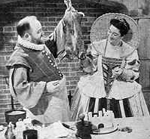 BBC Television stages an Elizabethan night: all programmes are presented in the costume of the period of Queen Elizabeth I. BBC Television stages an Elizabethan night: all programmes are presented in the costume of the period of Queen Elizabeth I.
Left: Then ubiquitous TV chef Philip Harbin cooks Tudor style for presenter Jeanne Heal. |
|
| November 27 |
KTBC TV begins broadcasting as a CBS affiliate in Austin, Texas. |
|
| November |
Specific proposals for Independent Television are made in a UK government memorandum on Television Policy. |
|
| November |
UK newspaper, the Daily Recorder, the first new national newspaper in 23 years, launches. It survives for less than five months. |
|
| • |
Disney approaches United Paramount Theaters, now owner of ABC Television, with the idea of building an amusement park. Already rejected by NBC and CBS, Disney is offered $0.5m, plus $17m raised against collateral of ABC's property holdings. In return, ABC receives a 35 per cent stake in Disneyland, a share of concessions revenue for 10 years and gains access to Disney's animation library. Disney also agrees to produce a weekly one-hour television show for ABC. |
|
| December 1 |
At the David Sarnoff Research Center, RCA demonstrates a longitudinal videotape recorder with three fixed heads in monochrome and colour. The tape speed is 360 ips and a 7,000 ft reel of half-inch plastic tape, 17 inches in diameter, gives only four minutes’ recording time. |
|
| December 2 |
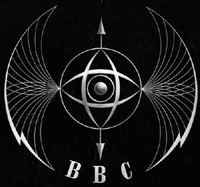 BBC Television introduces a new on-screen logo, designed by Abram Games, which is also produced in a moving version from a three-dimensional model—believed to be the world's first moving logo for a television service. BBC Television introduces a new on-screen logo, designed by Abram Games, which is also produced in a moving version from a three-dimensional model—believed to be the world's first moving logo for a television service. |
|
| December 2 |
US broadcasting network ABC merges with United Paramount Theatres. |
> 1962 |
| December 7 |
KKTV TV begins broadcasting as a CBS affiliate on channel 11 in Colorado Springs-Pueblo, Colorado. |
|
| December 10 |
WSLS TV begins broadcasting as an NBC affiliate on channel 10 in Roanoke, Virginia. |
|
| December 14 |
KROD TV (later KDBC) begins broadcasting as an CBS affiliate on channel 4 in El Paso, Texas. |
|
| December 15 |
KHON TV begins broadcasting as an NBC affiliate on channel 2 in Honolulu, Hawaii. |
|
| December 17 |
 FCC approves the revised RCA all-electronic colour television system and drops the CBS sequential colour system. Colour broadcasts can begin 30 days from now. RCA transmits its new NBC Chimes logo at 17:32 to celebrate. FCC approves the revised RCA all-electronic colour television system and drops the CBS sequential colour system. Colour broadcasts can begin 30 days from now. RCA transmits its new NBC Chimes logo at 17:32 to celebrate. |
Click on the logo to hear the chimes |
| December 20 |
KHQ TV begins broadcasting as an NBC affiliate on channel 6 in Spokane, Washington. |
|
| December 21 |
WSBT TV begins broadcasting as a CBS affiliate on channel 22 in South Bend, Indiana. |
|
| December 22 |
Independent station WSBA TV (later WPMT) opens on channel 43 at York, Pennsylvania. |
|
| December 30 |
US electronics manufacturer Admiral introduces the first new-style NTSC monochrome-compatible television receivers, priced at $1,175. |
|
| December |
Contracts are signed for the construction of transatlantic voice telephony cables between the UK, US and Canada. |
See 1956 September 25 |
| December |
CBC opens its fourth television station, CBUT Vancouver. |
|
| • |
First US cable pay TV system is set up in Palm Springs, California. Another is constructed in the Carmel/Pebble Beach area of California. Subsequently cable is introduced in a number of other US cities. Most operations are not successful. (Paramount has a large investment in pay TV in the 1950s.) |
|
| • |
Sylvania Electronic Products sets up an experimental 'satellite' transmitter, station KG2XDU, on a hill above its home town of Emporium, Pennsylvania. Signals are picked up, amplified and beamed by microwave to a UHF transmitter, KD2 XEL on channel 82, in downtown Emporium for local domestic reception. Both tarnsmitters are entirely automatic and unattended. |
|
| • |
Ernie and Charles Pearl and Bob Dean, former employees of Rank Screen Advertising, found the Pearl & Dean cinema advertising company. |
|
| • |
RKO withdraws from film production. |
|
| • |
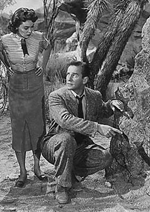 At some US theatrical performances of the black and white 3-D film It Came from Outer Space, the audience is pelted with foam rocks during a landslide sequence. Part of the short-lived spate of such titles, the film is shot in both flat and stereoscopic versions. At some US theatrical performances of the black and white 3-D film It Came from Outer Space, the audience is pelted with foam rocks during a landslide sequence. Part of the short-lived spate of such titles, the film is shot in both flat and stereoscopic versions. |
Spate of 3-D movies lacks depth |
| • |
Stage 1 of the BBC Television Centre at White City, West London—a scenery block—is brought into use. Other building work remains frozen by government restrictions on capital spending. |
|
| • |
Television Act is passed by the Australian federal government, creating a Royal Commission to oversee allocation of licences. The Australian Broadcasting Commission (ABC) is to provide a national service, commercial stations will operate in major cities, the first two licences being granted for Sydney and Melbourne. |
|
| • |
 C A Swanson & Sons, a US packaged food manufacturer, introduces the TV Dinner and registers the brand. The concept has existed since 1945 for airline use and as One-Eyed Eskimo frozen dinners for consumers since 1949 but Swanson heavily promotes the concept in association with convenience for television viewing. C A Swanson & Sons, a US packaged food manufacturer, introduces the TV Dinner and registers the brand. The concept has existed since 1945 for airline use and as One-Eyed Eskimo frozen dinners for consumers since 1949 but Swanson heavily promotes the concept in association with convenience for television viewing.
[Image source: Swanson/Pinnacle Foods] |
|
| • |
Entertainments tax is abolished by the Australian federal government. [0042] |
|
| • |
Firms in England, US and Germany begin manufacture of closed circuit and industrial television equipment. |
|
| • |
Estimated 100m feet of film are used in US for kinescoping (telerecording). |
|
| • |
Team at Toshiba in Japan led by Norikazu Sawazaki begins work on helical scan videotape recording. |
|
| • |
JVC begins research into video recording. |
|
| • |
First Indian film shot in Technicolor, using foreign technicians, is Jhansi Ki Rani (The Queen of Jhansi, also released in an English version as The Sword and the Flame), directed by Sohrab Modi (1897-1984). |
|
| • |
Television services begin in the Philippines and Switzerland. |
|
| • |
Emerson College opens the first educational closed circuit television system, WERS-TV, in New England. |
|
| • |
 Radio broadcasting service begins in Togo. [Left: Radio Togo logo] Radio broadcasting service begins in Togo. [Left: Radio Togo logo] |
|
| • |
Canadian wireless receiving licence fee is abolished and replaced annual parliamentary grants to CBC equivalent to a 15 per cent excise duty on all television and radio receivers and parts. |
|
| • |
First film made in Angola is a short documentary: Velhos Tempos, Novos Tempos (Old Times, New Times) by Asdrubal Rebelo da Silva. |
|
| • |
First feature film made in
• Guinea: Mouramani, directed by Mamadou Touré.
• Albania: Velikii Voin Albanii Skanderbeg (The Great Albanian Warrior Skanderbeg), a Soviet co-production. |
|
| • |
O Mein Papa by Eddie Calvert (‘The Man with the Golden Trumpet’) is the first British instrumental recording to achieve sales of a million discs. |
|
| • |
 Le Livre de Poche paperback imprint is launched in France by Hachette and Filipacchi. The first title is Pierre Benoit's Koenigsmark. [They are among the best-smelling (sic) books of all time.] Le Livre de Poche paperback imprint is launched in France by Hachette and Filipacchi. The first title is Pierre Benoit's Koenigsmark. [They are among the best-smelling (sic) books of all time.] |
|
| • |
 Disposable Bic ball-point pens, invented by Baron Michel Bich (1914-1994), are introduced in France. Disposable Bic ball-point pens, invented by Baron Michel Bich (1914-1994), are introduced in France. |
|