










|
|
|
|
|
|
|
|
|
|
|
|
| P |   Numbers after entries link to the list of references. Numbers after entries link to the list of references. |
< O | Q > |
 |
CAMILLE PAGLIA | 1947- ; American critic and feminist |
| Cinema is the culmination of the obsessive, mechanistic male drive in western culture. The movie projector is an Apollonian straightshooter, demonstrating the link between aggression and art. Every pictorial framing is a ritual limitation, a barred precinct. | • Sexual Personae, 1990 | |
 |
WILLIAM PALEY | 1901-1990; Chief executive of CBS |
| First, we have an obligation to give most of the people what they want most of the time. Second, our clients, as advertisers, need to reach most of the people most of the time. This is not perverted or inverted cause and effect, as our attackers claim. It is one of the great strengths of our kind of broadcasting that the advertiser’s desire to sell his product to the largest cross-section of the public coincides with our obligation to serve the largest cross-section of our audience. | • Speech to industry body, 1946, quoted in William Boddy: ‘The beginnings of American television’ in Anthony Smith (ed): Television: An international history, 1995 | |
 |
WILLIAM PALEY and FRANK STANTON | 1901-1990 and 1909- ; Chief executive and President (1946-1973) of CBS |
| [Pay TV] is a complex system that would force people to pay for looking at their own screens, ... a betrayal of the 34 million families that have already spent $13½ billion for their sets in the anticipation that they would be able to watch them as much as they wanted without paying for the prerogative. | • message to CBS shareholders, 1955? see also  Frank Stanton Frank Stanton |
|
 |
ERWIN PANOFSKY | 1892-1968; German-born American art historian |
| I cannot remember a more misleading statement than Mr Eric Russell Bentley’s in the Spring Number of the Kenyon Review, 1945: ‘The potentialities of the talking screen differ from those of the silent screen in adding the dimension of dialogue—which could be poetry.’ I would suggest: ‘The potentialities of the talking screen differ from those of the silent screen in integrating visible movement with dialogue which, therefore, had better not be poetry.’ | • ‘Style and medium in the motion pictures’ in Critique, January-February 1947, vol 1 no 3 | |
| PAULO ANTONIO PARANAGUÁ | 1892-1968; Mexican cinema historian | |
| Longe de Deus e perto de Hollywood. [So far from God and so near to Hollywood.] |
• Subtitle of Latin American Cinema, 1985 | |
 |
Sir ALAN PARKER | 1944- ; British film director |
| 1 I still feel the old working class bit that any day now someone is going to tap me on the shoulder and say, ‘The game’s up, son. Now back to Islington.’ | • A Turnip-head’s Guide to the British Cinema, February 1982 | |
2 Narcolepsy: A state of sleep brought on by watching films like The Draughtsman’s Contract. |
• cartoon in Screen International, 8 January 1983 | |
| 3 There’s no colour prejudice in Hollywood. It’s not black or white—it’s green. All they’re chasing is the buck; they’ll make whatever they think will succeed. | • interview in The Independent, 14 April 1989 | |
| 4 I felt more than a little guilt when our hamburger-munching army invaded the lives of people living in abject poverty and all we saw was a ‘great location’. | • about the making of Mississippi Burning, interview in The Independent, 14 April 1989 | |
 |
ROBERT W PAUL | 1869-1943; Pioneer British film-maker |
| The public has seen too many trains, trams and buses. And with the exception of a few films whose humour is too French to please the British, one could say that no one up to now has begun to exploit the possibilities of moving pictures to make us laugh, cry or be amazed. | • 1898 | |
| WILLIAM HOYT PECK | President, Peck Television Corporation | |
| Television is already here. It meets all the requirements laid down by critics,
at least as far as my system is concerned, which will provide images up to two
by three feet, with detail comparable to that of home movie pictures, and bright
enough to be clearly visible in a room containing two or three floor lamps. Mechanical scanning will, in my opinion, be the most popular system. It affords a more sharply defined picture element than does the cathode ray tube, replacement of light source is necessary at longer intervals and costs but 10 cents instead of many dollars. |
• 'What 1935 holds forth for television and facsimile' in Radio News and Short Wave Radio, Washington, January 1935 | |
| ROONEY PELLETIER | Controller of BBC Light Programme | |
| The more I think about it, the more I believe that death of a violent kind in The Archers timed if possible to diminish interest in the opening of commercial television in London is a good thing. | • letter to Denis Morris, head of Midland Regional Programmes, 11 May
1955; cit. Asa Briggs: The History of British Broadcasting, volume IV: Sound & Vision 1955 September 22—opening night of commercial television 1955 September 22—opening night of commercial television |
|
| Dr YURI PELYOSHONOK | Soviet-born Canadian academic in Soviet Studies | |
| The Soviet authorities thought of the Beatles as a secret Cold War weapon. The kids lost their interest in all Soviet unshakable dogmas and ideals, and stopped thinking of an English-speaking person as the enemy. That's when the Communists lost two generations of young people ideologically; totally lost. That was an incredible impact. | • The Beatles Revolution, ABC Television documentary, November 2000 See also Milos Forman |
|
| MILTON PERCIVAL and R A JELLIFFEE | ||
| Manifestly, wireless telegraphy is destined to become a great civilising and socialising agency, because the firmament of the world is the common property of all nations, and those who use it for signalling inhabit it, in a certain sense. When all nations come to inhabit the firmament collectively they will be brought into closer communion, for their mutual advantage. A new upper geography dawns upon us, in which there is no more sea, neither are there any boundaries between the peoples. | • Specimens of Exposition and Argument, 1908 | |
 |
GEORGES PEREC | 1936-1982; French writer, member of Oulipo |
| What I miss above all is the neighbourhood cinema, with its ghastly advertisements for the dry cleaner's on the corner. | • 'Death of the Neighbourhood' in Species of Spaces (Espèces d'Espaces) | |
 |
SHIMON PERES | 1923- ; Israeli politician |
| Television has made dictatorship impossible but democracy unbearable. | • quoted in the Financial Times, 31 January 1995 | |
 |
DAVID PLOWRIGHT | 1930-2006; Programme Controller, Granada Television; later Chairman, Granada Television; deputy Chairman Channel Four Television |
| The mood in that time was that advertising time perishes very quickly. We didn't apply the same rigour ro dealing with bad industrial relations practice as we did to getting controversial programmes on the air. Peaceful industrial relations took precedence over innovative programme making. | • about the strikes in ITV c.1970, quoted in Michael Darlow: Independents Struggle [0063] | |
 |
ROMAN POLANSKI | 1933- ; Polish-born film director |
| Cinema should make you forget you are sitting in a theatre. | • Source unknown | |
 |
EUGENE POLLEY | 1916- ; American electronics engineer |
| It makes me think maybe my life wasn't wasted. Maybe I did something for humanity—like the guy who invented the flush toilet. | • of his 1955 Flash-Matic television remote control device, antecedent to the following year's Space Command for which Dr Robert Adler is well known. Quoted in Baltimore Sun, 22 November 2000 | |
 |
ERICH POMMER | 1889-1966; German film producer, who later worked in the UK and Hollywood |
| I think that European producers must at last think of establishing a certain co-operation among themselves. It is imperative to create a system of regular trade which will enable the producers to amortise their films rapidly. It is necessary to create 'European films', which will no longer be French, British, Italian or German films; entirely 'continental' films, expanding out into all Europe and amortising their enormous costs, can be produced easily. | • Cinémagazine, 4 July 1924 [0036] | |
 |
JIMMY POP | American singer, songwriter/lyricist |
| You and me, babe, we ain't nothing but mammals So let's do it like they do on the Discovery Channel. |
• The Bad Touch, Hooray for Boobies album by Bloodhound Gang, 1998 | |
 |
COLE PORTER | 1892-1964; American songwriter/lyricist |
| In glorious Technicolor, breathtaking CinemaScope and stereophonic sound. | • 'Stereophonic Sound' from Silk Stockings, 1955. Although originally produced on the stage, where such things did not count, the film version was in glorious Metrocolor, breathtaking Panavision and Perspecta sound | |
 |
EDWIN S PORTER | 1869-1941; Pioneer American film-maker, (incorrectly) credited with directing the first story film |
| If the public were content to receive and support the mediocre films that marked the inauguration of the business, this standard would still be acceptable. The public owes thanks only to itself for its ability today to see the beautiful, refined and artistic presentations of the screen. As for the producers, they should be content to know that public encouragement proved the inspiration that it did, and should be thankful that they were given the strength and the light to accomplish the great things which that public encouragement suggested. | • The Moving Picture World, 11 July 1914 | |
 |
RAYMOND POSTGATE | Raymond William Postgate 1896-1971; English journalist, writer and social historian |
| Not more than 10 per cent of the population will take up television permanently. | • What To Do With the BBC, 1935 | |
 |
DENNIS POTTER | 1935-1994; British television dramatist |
| 1 Never in the entire history of drama in all its forms has so much been produced for so large an audience with so little thought. | • Edinburgh Television Festival, 1977 | |
| 2 I first saw television when I was in my late teens. It made my heart pound. Here was a medium of great power, of potentially wondrous delights, that could slice through all the tedious hierarchies of the printed word and help to emancipate us from many of the stifling tyrannies of class status and gutter-press ignorance. At a crucial period of my life it threw open the ‘magic casement’ on great sources of mind-scape. | • source unknown | |
| 3 You cannot make a pair of croak-voiced Daleks appear benevolent if you dress one in Armani suits and call the other Marmaduke. The world has been turned upside down. The BBC is under governors who seem incapable of performing the trust that is invested in them, under a chairman who seems to believe he is heading a private fiefdom, and a chief executive who must somehow or other have swallowed whole and unsalted the kind of humbug punctuated pre-privatisation manual that is being forced on British Rail or British Coal. | • McTaggart Lecture, Edinburgh International Television Festival, 1993 | |
 |
MICHAEL POWELL and EMERIC PRESSBURGER | 1905-1990, 1902-1988; British film-makers |
| One is starved for Technicolor up there. | • Conductor 71 character (played by Marius Goring) in A Matter of Life and Death, 1946; referring to the afterlife. The earthbound sequences of the film are in colour. | |
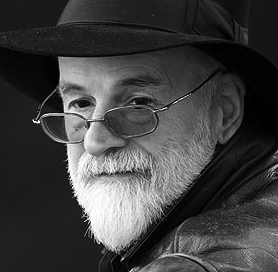 |
TERRY PRATCHETT | Sir Terence David John Pratchett OBE 1948- ; English fantasy writer |
| There's always Hollywood interest, but Hollywood is full to the brim of people who have the ability to say no and only about one person who can say yes. You could die waiting for Hollywood. | • Of his Discworld novels; interview in The Guardian, 22 April 2013. | |
 |
WILLIAM PREECE | Sir William Henry Preece 1834-1913; Chief engineer, General Post Office, UK and supporter of Marconi’s experiments |
| The Americans have need of the telephone, but we do not. We have plenty of messenger boys. | • 1876 | |
 |
J B PRIESTLEY | John Boynton Priestley 1894-1984; English novelist and playwright |
| 1 The modern world, William reflected, was becoming more and more something to be filmed; this was primarily the age of celluloid; and soon it might be impossible to distinguish between reality and film stuff, so that you would not know if you were witnessing an historical event or a scene arranged by a film company. Indeed, the two might soon be the same, and nations might go to war with the active and benevolent co-operation of Mr Sapphire [a film producer] and his colleagues. | • Faraway, 1932. Published just as the Nazis were coming to power in Germany, could this be seen as prophetic in the light of the Nazis' use of film? | |
| 2 Post-war England [...] miles of semi-detached bungalows, all with their little garages ... their wireless sets, their periodicals about film stars, their swimming costumes and tennis rackets and dancing shoes. ... The very modern things, like the films and the wireless and the sixpenny stores, are absolutely democratic, making no distinction between their patrons. | • English Journey, 1934 | |
| 3 Already we Viewers, when not viewing, have begun to whisper to one another that the more we elaborate our means of communication, the less we communicate. | • Televiewing, 1957 See also Anonymous,
Henry David Thoreau |
|
 |
DAWN PRIMAROLO | 1954- ; Labour politician; Paymaster-General |
| What we need is film-makers of vision, backed by investors who share that vision. What we don't need is investors who don't care. | • Announcing removal of tax allowances from film investors not directly involved in running film partnerships. Quoted in The Times 12 February 2004 | |
 |
VSEVOLOD I PUDOVKIN | 1893-1953; Soviet film-maker, theorist |
| 1 The film is the greatest teacher because it teaches us not only through the brain but through the whole body. | • quoted in Prof C H Waddington: ‘Two conversations with Pudovkin’ in Sight and Sound, Winter 1948/49 | |
| 2 Film is the supreme medium in which we can express ourselves today and tomorrow. | ||
| 3 Slow motion is ... a close-up in time. | See also Gilbert Adair,
Robert Altman |
|
 |
GARY PUNCH | 1957- ; Australian Minister for the Arts and Territories January-September 1988 |
| A healthy and vibrant domestic [film] industry is vital in promoting our cultural identity and projecting a positive image of Australians. | • on formation of Film Finance Corporation, May 1988 | |
 |
DAVID PUTTNAM | David Terence Puttnam CBE, Baron Puttnam of Queensgate 1941- ; British film producer |
| 1 The money’s often an excuse to cover the terror that lies at the heart of a producer because he doesn’t actually know who is the right person for the project. If he pays enough money, he must be de facto the right person. | • Screen International, June 1980 | |
| 2 I make films for people to see. If I have a message to convey, I should convey it in whatever way the audience prefers to see it. In Britain the audience has an expressed preference to see my work on television. | • Independent Production Handbook: Film & Video, 1982 | |
| 3 In a world in which the influence of the moving image is increasingly ubiquitous,we need to realise what the consequences might be if we fail to offer an alternative to Walt Disney's version of history. | • Speech to the National Association of Head Teachers, Jersey, 31 May 2000. His comment was
particularly concerned with the Disney film Dinosaurs See also Sherl Bearlstrom |
|
| < O | Q > | |
Page updated 29 April 2013
Compilation and notes © David Fisher