| 1899 |
 Chronomedia index Chronomedia index
Numbers after entries link to the list of references. |
links and notes |
| March 27 |
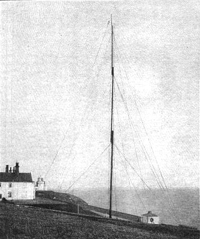 Marconi receives the first wireless signals across the English Channel at his ship-to-shore station at South Foreland Lighthouse near Dover [left] from Boulogne, France. Marconi receives the first wireless signals across the English Channel at his ship-to-shore station at South Foreland Lighthouse near Dover [left] from Boulogne, France. |
|
| March |
Edward Raymond Turner patents an additive three-colour film system. Developed in the UK with financial backing from Frederick Marshall Lee, the camera operates at 48 frames per second, using red, green and blue filters. |
> 1903 |
| March-December |
Around 30 films are made for the Queensland state government in Australia by government photographer Fred C Wills to promote immigration to the state. These may have been the first sponsored documentary and first state-funded productions. |
|
| • |
Birt Acres and R W Paul open a film studio in north London, the first in the UK. |
|
| • |
A C Bromhead of the Gaumont Ltd film agency in London establishes an open-air film studio on a four-acre cricket ground site at Loughborough Junction in Brixton, south London. |
> 1901 January |
| • |
Cecil Hepworth leases a house at Walton-on-Thames for £36 a year, builds a film studio in the back garden and establishes his own production company, Hepwix. |
|
| • |
Sultan of Turkey has his country’s first film show in private, given by Don Ramirez, a Spanish showman, who then opens the show at his Electric Circus in Constantinople. |
|
| • |
Marconi transmits wireless telegraph reports on the Americas Cup yacht race from off the New England coast to New York; messages reach New York within 75 seconds. |
|
| November |
First film known to have been made by an Indian (cf 1897): The Wrestlers, directed by Harishchandra Sakharam Bhatavdekar (1868-?) in Bombay, using a Riley camera acquired from London in 1898. |
|
| • |
Georges Méliès’ productions start to become significantly longer: Cendrillon (Cinderella) is 410 feet (seven minutes), L’Affaire Dreyfus is 240 metres (13 minutes). |
|
| • |
Circus owner J A W Grönross establishes Pohjola, the first film production company in Finland. |
|
| • |
American Mutoscope Company changes its name to American Mutoscope & Biograph Company. It becomes generally knows as just Biograph. The company makes the first film of a living US president, William McKinley and W K L Dickson makes the first film of a Pope at the Vatican. Its film of the Jeffries-Sharkey prize fight is a success, especially in those US states that ban live boxing. The outcome of the fight is already well known from press reports but this does not affect attendances. |
> 2006 |
| • |
Danish physicist Valdemar Poulsen patents the telegraphone, a device for recording sound on a steel wire, similar to piano wire. |
|
| • |
 Painting of the dog Nipper by Francis Barraud [right] is bought by William Barry Owen. The painting is named 'His Master's Voice'. Painting of the dog Nipper by Francis Barraud [right] is bought by William Barry Owen. The painting is named 'His Master's Voice'. |
|