






|
|
|
|
|
|
|
|
|
|
|
|
| 1923 |  Chronomedia index Chronomedia indexNumbers after entries link to the list of references. |
links and notes |
| January 8 | First BBC outside broadcast: a relay of The Magic Flute from Covent Garden. | |
| January 17 | Last wireless broadcast is made from 2MT Writtle by Marconi Company. | |
| January 18 | BBC obtains a formal licence to broadcast, issued by Postmaster General Neville Chamberlain. | |
| January 19 | Radio station WMC begins transmissions in Memphis, Tennessee. | |
| January 24 | BBC makes its first broadcast of late-night dance music. | |
| January 27 | Second ‘talk’ broadcast by the BBC is entitled 'How to Catch a Tiger'. | |
| February 13 | BBC’s Cardiff station (5WA on 353m) opens at 2 Castle Street; the transmitter is at the Castle Avenue Electricity works. | |
| February 16 | First BBC radio drama broadcast: the quarrel scene from Shakespeare’s Julius Caesar is broadcast from 2LO Marconi House. | |
| February 17 | First charitable appeal is broadcast by the BBC. | |
| March 2 | First issue of Time magazine, founded by Henry Luce and Briton Haddon, is published. | |
| March 6 | BBC’s Glasgow station (5SC on 420m) opens at 202 Bath Street, with the transmitter at Port Dundas. | |
| March 13 | Musical sounds recorded on film, using his Phonofilm system, are demonstrated by Dr Lee De Forest in New York. | > April 15 |
| March 23 | First live broadcast of dance music in UK is made by the Wireless Orchestra 'augmented by saxophones'. | |
| March 26 | BBC introduces a daily weather forecast. | |
| March | Columbia Gramophone Manufacturing Company sells its Dictaphone subsidiary for $1m in a further effort to save itself from bankruptcy. | |
| early in year | BBC broadcasts a sponsored concert, presented by Harrods department store. | |
| April 1 | First Norwegian radio programme transmission from 500W transmitter at Tryvannshøda. | |
| April 15 | Dr Lee De Forest demonstrates his Phonofilm sound-on-film process to a paying audience at the Rialto Theater, New York. He has produced eight short sound films that are shown as a support programme for the Paramount film Bella Donna. Adolph Zukor, the head of Paramount, makes the on-film introduction. De Forest's system incorporates a Western Electric amplifier and two components invented by Theodore W Case: the AEO light source and the Thalofide photoelectric cell. The soundtrack is on the same film as the picture. (In a letter of 11 February 1924, De Forest concedes that it should be called the De Forest-Case system.) In the following months, the system is installed in 34 East Coast US cinemas, including the Capitol and Rivoli cinemas in New York, and in the Tivoli in London. [0025] |
|
| May 1 | BBC moves to studios in the premises of the Institution of Electrical Engineers, Savoy Hill, London. | |
| June 14 | Fiddlin' John Carson playing The Little Old Log Cabin in the Lane is recorded by Ralph Peer of Okeh Records, said to be the first country music recording. Two recordings made by Carson later in the year, You'll Never Miss Your Mother Till She's Gone and Old Joe Clark, become million sellers. After moving to Victor, Peer later discovers and records Jimmie Rodgers, the Carter family and other country stars. | |
| • | De Forest Phonofilms is registered as a company in the UK and makes experimental short films at Cranmer Court Studios in Clapham, south London, using a sound-on-film technique for the next three years. The studios are built under the railway arches—not the best location for a sound film studio. Described in Leslie Wood’s The Romance of the Movies: ‘With trains thundering past every few minutes, ... production difficulties were tremendous. ... The room in which we worked at Clapham was just large enough to accommodate one set, and was heavily padded to keep out unnecessary noises; it also kept out fresh air.’ | |
| June | Phonofilm sound-on-film shorts are shown at the Finsbury Park Cinema, London. | |
| June 27 | 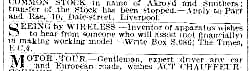 J L Baird advertises in The Times personal column: ‘Seeing by Wireless—inventor of apparatus wishes to hear from someone who will assist (not financially) in making working model.’ His experiments are being conducted at 21 Linton Crescent, Hastings, Sussex. J L Baird advertises in The Times personal column: ‘Seeing by Wireless—inventor of apparatus wishes to hear from someone who will assist (not financially) in making working model.’ His experiments are being conducted at 21 Linton Crescent, Hastings, Sussex. |
|
| July 1 | AT&T forms the first US radio network by linking WEAF New York and WMAF in Boston, Massachusetts. | |
| July 5 | Cine Kodak Model A film camera and Model A motorised Kodascope projector—the first complete 16mm system—are introduced in the US. | |
| July 11 | G A Atkinson is appointed BBC film critic. | |
| July 16 | Censorship of Films Act is passed in the Irish Free State parliament. It establishes the Office of the Official Film Censor and the Censorship of Films Appeals Board, both appointed by the Minister for Home Affairs. It amends the British Cinematograph Act 1909 to remove from local councils any authority to include conditions about the nature of films in licences they grant for cinemas. | Read the Act here (opens in new window) |
| July 19 | Radio station WRC goes on air in Washington DC. | |
| August 29 | News bulletin is broadcast simultaneously by all BBC regional stations. | |
| August | BBC Birmingham studio is moved to over The Picture House, New Street. | |
| September 28 | First issue of BBC’s Radio Times is published. | |
| October 1 | Broadcasting Committee (chairman: Sir Frederick Sykes) reports on the organisation, control and funding of UK broadcasting. It decides against advertising as a means of funding but in favour of limited sponsorship. | |
| October 9 | BBC broadcasts live speeches from the Lord Mayor's banquet in London. | |
| October 10 | BBC radio station at Aberdeen (2BD on 495m) opens at 17 Belmont Street, transmitting from Aberdeen Steam Laundry. [Is this the origin of the term 'steam radio'?] | |
| October 12 | 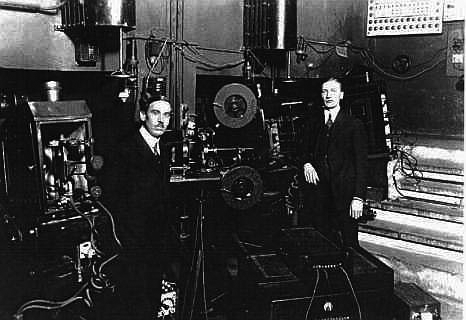 Axel Petersen and Arnold Poulsen demonstrate their patented sound-film system using two interlocked machines—one for picture, one for optical sound—at the Palads Teatret, Copenhagen. The system is subsequently used by Gaumont in France, Tonfilm in Germany and Gaumont-British in the UK. Axel Petersen and Arnold Poulsen demonstrate their patented sound-film system using two interlocked machines—one for picture, one for optical sound—at the Palads Teatret, Copenhagen. The system is subsequently used by Gaumont in France, Tonfilm in Germany and Gaumont-British in the UK. |
|
| October 16 | Walt Disney Company is founded. | |
| October 17 | BBC radio station at Bournemouth (6BM on 385m) opens at 72 Holdenhurst Road, with the transmitter at North Cemetery. | |
| October 29 | First German medium wave transmissions begin from the top of the Vox Haus in Berlin on 400m. | Listen to the opening announcement |
| October | J G Jones proposes a modification to the perforations of standard 35mm film release prints to avoid tears at the corners: rounded corners. The idea is adopted by Society of Motion Picture Engineers Standards Committee in 1928. | |
| October | International Congress of Cinema Managers is held in Paris. [0038] | |
| October | Western Electric's management reluctantly agrees a project to develop a practical sound-on-film system as well as the sound-on-disc system already demonstrated. | |
| October | In US, Columbia Gramophone Manufacturing Company goes into liquidation with debts of $21m and assets of $19m, apparently a victim of the public’s interest in buying and using wireless receivers. | See also 1925 |
| November 8 | First BBC radio transmission from Cardiff in Welsh. | |
| November 14 | John Reith (formerly general manager) becomes managing director of the BBC. | |
| November 24 | Radio Belgique begins transmissions. | |
| November 26 | BBC in London and KDKA in Pittsburg, Pennsylvania conduct the first experimental transatlantic radio relay broadcast. | |
| December 6 | President Calvin Coolidge makes the first presidential address on US radio. | |
| December | Pathé Baby 9.5mm film camera, designed by Ferdinand Zecca, is introduced commercially by Pathé Cinéma in France. | |
| Canadian National Railways, which soon owns licensed radio stations, experiments with radio broadcasts to moving trains from a studio in Montreal; receiving sets, operated by uniformed staff, are installed in many of its parlour cars. These transmissions continue until 1931. | ||
| December 29 | Vladimir Zworykin applies for a US patent for an electronic television camera tube, later called the iconoscope. | > 1938 |
| December 29 | John Logie Baird applies for a patent for a spiral scanning disc for use in a television system. | > 1925 |
| December 30 | BBC conducts a cross-channel landline relay from Radiola Paris. | |
| December 30 | First Canadian radio network transmission is arranged by Canadian National Railways, linking stations CHYC Montreal and OA Ottawa. | |
| December 31 | First broadcast of the chimes of Big Ben by the BBC. | |
| December 31 | The BBC now has 177 employees, an increase of 173 in one year. | |
| December 31 | Transatlantic radio voice transmission is made from Pittsburgh to Manchester. | |
| December 31 | In UK 595,496 wireless receiving licences are current. | |
| • | 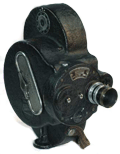 Bell & Howell introduces the first 16mm camera, model 70A, using 16mm rather than 17.5mm because the latter could be achieved by slitting combustible nitrate stock whereas 16mm film is specially made by Eastman Kodak on a safety base. Demand for the camera is not filled until 1930. Bell & Howell introduces the first 16mm camera, model 70A, using 16mm rather than 17.5mm because the latter could be achieved by slitting combustible nitrate stock whereas 16mm film is specially made by Eastman Kodak on a safety base. Demand for the camera is not filled until 1930. |
|
| • | Urban Motion Picture Industries in the US markets a new model of the Spirograph, a disc-based film projector invented in 1907. | |
| • | First continental broadcast to the UK is made by landline from Radiola, Paris. | |
| • | Suomen Biografiliitto is formed in Finland. Its name is changed to Suomen Filmikameri (Finnish Film Chamber) in 1939. | |
| • | Warner Bros Company is formed by brothers Albert, Harry, Jack and Sam. | |
| • | Only 10 per cent of films shown in UK cinemas during the year are British. In Australia, 94 per cent of all film releases are from the US. | |
| • | Film censorship is officially introduced into Italian law. | |
| • | First Bolivian feature film, Profecia del Lago (Prophecy of the Lake), directed by José Maria Velasco Maidana, is banned by the authorities. | |
| • | René Clair’s film Entr’acte has music composed by Eric Satie. | |
| • | First Icelandic film: Aevintyri Jons og Gvendar (The Adventures of Jon and Gvendur), directed by Loftur Gudmundsson. | > 1948 |
| • | 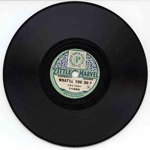 Woolworths stores in the UK begin selling their own range of Little Marvel records, which sell for 6d (2½p) each. The five-inch discs play at 80rpm and are made by Vocalion. Although the stores are not able to play the recordings until equipped with gramophones in the 1930s, the records sell well. Woolworths stores in the UK begin selling their own range of Little Marvel records, which sell for 6d (2½p) each. The five-inch discs play at 80rpm and are made by Vocalion. Although the stores are not able to play the recordings until equipped with gramophones in the 1930s, the records sell well.[Image: Woolworths Virtual Museum] |
> 1927 |
| • | Victor Records sales pass the $50m mark. |
Page updated 25 February 2011
© David Fisher