| 1951 |
 Chronomedia index Chronomedia index
Numbers after entries link to the list of references. |
links and notes |
| |
Cultural highlights | Predictions made this year |
|
| January 1 |
The British Board of Film Censors replaces the little used H certificate with the X certificate, recommended by the Wheare Committee on Children and the Cinema. |
|
| January 7 |
Cardinal Francis Spellman, head of the New York Roman Catholic diocese, condemns Roberto Rossellini's film The Miracle, and declares that it is 'a blot upon the escutcheon of the Empire State [New York] that no means of appeal to the Board of Regents is available to the people for the correcting of the mistake made by its motion picture division'. Intense picketing begins outside the Paris cinema in Manhattan, where the film is showing. |
> February 15 |
| January 12 |
The first X-certificate film, La Vie Commence Demain, which contains a sequence dealing with artificial insemination, opens at the Cameo-Poly cinema in London. |
|
| January 17 |
Beveridge Report on UK broadcasting is published, recommending further development of television, more regional autonomy and a higher licence fee. |
|
| January |
Television service starts in Brazil. The commercial service is owned by multi-media tycoon Francisco de Assis Chateaubriand, who already controls 16 radio stations, 28 daily newspapers and other media interests. |
|
| February 1 |
First cineradiography (moving X-ray) system is demonstrated. |
|
| February 1 |
Nuclear explosion is televised in the USA. |
|
| February 6 |
A reciprocal distribution deal between the J Arthur Rank Organisation and Eagle Lion Classics, under which Eagle Lion distributed some Rank films in the western hemisphere and Rank handled Eagle Lion films in the UK, is terminated after three years. |
|
| February 15 |
After sustained pressure, New York's Board of Regents withdraws the licence granted to the film The Miracle, on the grounds that it is sacrilegious.
[0032] |
|
| February |
Cellulose acetate replaces potentially chemically unstable cellulose nitrate as the base for professional film stocks. |
|
| February |
First commercial computer using the University of Manchester's design is delivered by British electronics company Ferranti. Known as the Ferranti Mark 1, its programming manual is written by Alan Turing. |
> 1959 |
| • |
Pay TV experiments continue in US: Telemeter system on KTLA-TV Los Angeles and Zenith’s Phonevision over its own experimental station W9XZV in Chicago. |
|
| May 3 |
Official opening of the Festival of Britain, based on the South Bank site of the River Thames in London. |
|
| May 4 |
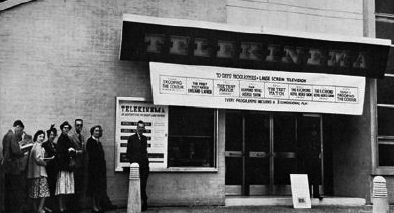 As part of the Festival of Britain, the Telekinema shows 3D and stereophonic films, as well as live large-screen transmissions of interviews from a nearby studio. As part of the Festival of Britain, the Telekinema shows 3D and stereophonic films, as well as live large-screen transmissions of interviews from a nearby studio. |
The Telekinema later becomes the National Film Theatre. |
| • |
Among the 3D films made or released in the UK this year are Distant Thames (later retitled Royal River) using the Stereo-Techniques technology developed by Raymond and Nigel L Spottiswood, directed by Brian Smith, camera by Stanley W Sayer and stereo sound by Ken Cameron. |
|
| May 28 |
First edition of Radio’s Own Crazy People, ‘The Goons’ (renamed The Goon Show in 1952) on BBC Light Programme. |
|
| May |
Italy reaches agreement with the Motion Picture Export Association of America (MPEA) that eight US companies will be allowed to import 225 films a year and Italian distributors will be allowed to import 60 American films a year, all dubbed into Italian. The eight US companies are Columbia, MGM, Paramount, Republic, RKO, Twentieth Century-Fox, United Artists and Universal. The agreement is to run for two years but is extended. |
See 1949. |
| June 6 |
Berlin Film Festival is established by Dr Alfred Bauer. The first film shown is Rebecca, directed by Alfred Hitchcock. |
|
| June 14 |
First commercial computer in the USA, UNIVAC 1, is demonstrated by Dr John W Mauchly and J Prosper Eckert Jr. The first model is delivered to the US Bureau of the Census. |
< February |
| June 21 |
CBS colour television programme output increases to 4½ hours a week.
July 14 CBS televises a horse race in colour.
August 11 CBS televises the first baseball game (Braves v Dodgers) in colour. |
|
| June 25 |
First US television network broadcast (to four other cities) using the then NTSC colour system is made by CBS from New York. The programme is the Arthur Godfrey Show. [At this time, colour television studio signal processing equipment requires up to five times as much floor space as monochrome, affecting the design of studio buildings.] |
> 1953 |
| July 2 |
Radio Luxembourg moves its English-language transmissions—based on disc jockey programming, quiz shows and competitions—from long wave to 208m MW. It continues to include shows like Opportunity Knocks and Double Your Money that later transfer to Independent Television in the UK. |
|
| August 31 |
Deutsche Grammophon Gesellschaft (DGG) issues the first 33 rpm LP in Germany. |
|
| September 4 |
Opening of the Japanese treaty conference in San Francisco is the first coast-to-coast US television transmission, carried on 94 stations. |
|
| September 12 |
Underwater television equipment is successfully used to identify the submarine Affray, which had been lost in the English Channel during exercises. |
|
| September 20 |
Production of the first receivers for the CBS sequential colour system begins at the Air-King electronics manufacturing subsidiary of Hytron Radio and Electronics Corporation. CBS bought Hytron, according to presidnet Frank Stanton, 'to assure at least some source for colour receivers to the public'. The sets go on sale at Gimbels store in New York, priced at $499.95. Rival manufacturer Allan B DuMont claims that only 200 units are made, of which half are sold. |
|
| September 23 |
First transcontinental television relay is made by CBS from New York to the US west coast. |
|
| September 24 |
CBS colour television programme output increases to 7½ hours a week. |
|
| September 29 |
CBS televises the first American football game in colour from Philadelphia. |
|
| September |
Start of ‘hot-kine’ era of US television recording. Transcontinental microwave television transmission system is completed and all three networks, desiring to maintain a uniform programme schedule in the face of three-hour East-West time difference, develop a fast system of recording television using film. Recordings are made on 35mm film which is quickly developed, washed and dried and projected as a negative. |
|
| September |
Television test transmissions begin on Channel 7 in Argentina. |
> November |
| October 2 |
Television service is officially inaugurated in the Netherlands. |
|
| October 12 |
Opening of Holme Moss transmitter brings BBC Television to northern England. |
|
| October 15 |
In the UK general election campaign (voting taking place on October 25), each of the three main parties is allocated 15 minutes of television time to make party political broadcasts. So in the first party political broadcast on British television, Lord Samuel speaks on behalf of the Liberal Party. |
|
| October 15 |
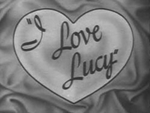 First broadcast of the first filmed television series on US networks: I Love Lucy. Shot in a fringe Hollywood studio, bought by production company Desilu from Howard Hughes, it quickly becomes a ratings leader, achieving peak audience of 44m for a single transmission; shown by 149 US stations and on television networks in 29 other countries. It is followed within months by other filmed series, like Dragnet. First broadcast of the first filmed television series on US networks: I Love Lucy. Shot in a fringe Hollywood studio, bought by production company Desilu from Howard Hughes, it quickly becomes a ratings leader, achieving peak audience of 44m for a single transmission; shown by 149 US stations and on television networks in 29 other countries. It is followed within months by other filmed series, like Dragnet. |
|
| October 15 |
CBS colour television programme output increases to 12 hours a week. It still has no sponsors for any of the shows. |
|
| • |
Columbia Pictures establishes Screen Gems subsidiary to produce filmed material for television. |
|
| October 19 |
All US colour television receiver production banned for the duration of Korean War. |
|
| October 20 |
Football game between North Carolina and Maryland is the last CBS colour television transmission. CBS recalls all sets sold to date. |
|
| October 27 |
Hospital radio broadcast is made for first time in the UK by relaying the commentary on a Portsmouth v Newcastle football match to a Portsmouth hospital. |
|
| October |
British Lion Film Corporation is unable to repay a huge loan from the National Film Finance Corporation without disposing of assets. |
|
| November 5 |
The word ‘Eurovision’ is used by British journalist George Campey in the London Evening Standard. The BBC prefers the term 'Television Continental Exchange'. |
|
| November 10 |
Coast-to-coast direct-dial telephone service is first offered in the USA. |
|
| November 11 |
Bing Crosby Enterprises mounts the first successful demonstration of black and white magnetic video recording. A modified Ampex audio recorder is used with one-inch wide tape on which the video is split by bandwidth into 10 tracks, with FM audio and vertical and horizontal sync pulses on the 11th and 12th tracks. The tape runs at 100 inches (2.54m) per second. According to chief engineer John Mullin, the resulting quality is negligible. |
|
| November 18 |
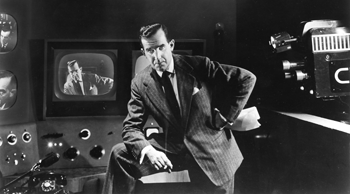 First live coast-to-coast commercial television broadcast in the USA is See It Now. This opening programme of the series, hosted by Edward R Murrow from Studio 41 at CBS in New York, includes a split screen view of the Brooklyn Bridge in New York and the Golden Gate Bridge in San Francisco. The show sets a standard for television journalism that the US has rarely aspired to since. First live coast-to-coast commercial television broadcast in the USA is See It Now. This opening programme of the series, hosted by Edward R Murrow from Studio 41 at CBS in New York, includes a split screen view of the Brooklyn Bridge in New York and the Golden Gate Bridge in San Francisco. The show sets a standard for television journalism that the US has rarely aspired to since. |
 |
| November 20 |
Production of colour television receivers for sale to the public is banned in the USA under Order M-90 issued by the National Production Authority. |
|
| November |
Television service starts in Argentina. |
< September |
| November |
Stock evaluation of a UK bakery’s output is the first successful business application of electronic computing. Commissioned by J Lyons, the caterers, a computer is specially built, by a team led by John Pinkerton (1919-1998), with the name Leo (Lyons Electronic Office). Around 15 years later, Leo Computers merges, under government influence, with Eliot Automation, English Electric Computers and Marconi Computers to form International Computers and Tabulators (ICT) to compete in the world computer market. |
|
| December 24 |
First opera written specially for television, Gian Carlo Menotti’s Amahl and the Night Visitors, is broadcast in the US by NBC. |
< 1947 |
| December |
Alexander Poniatoff, head of Ampex, authorises a project with a budget of $14,500, led by Charles Ginsburg, to investigate videotape recording. As a project is has relatively low priority and is suspended from time to time. |
|
| • |
Australian federal Capital Issues Board prohibits formation of new film production companies with capital exceeding £10,000. |
|
| • |
To comply with the Supreme Court ruling in the 'Paramount consent decree' case, Paramount Studios hives off its cinema exhibition business, which becomes United Paramount Theaters. |
> 1953 |
| • |
Associated British Picture Corporation (ABPC) sells Welwyn Studios to a tobacco company. |
|
| • |
French film magazine Cahiers du Cinéma (Cinema Notebooks) is founded by André Bazin. Its editor is Eric Rohmer. |
> 1963 |
| • |
First nude scene in a German film: Hildegard Knef appears naked in Die Sünderin (The Sinner). |
|
| • |
First feature film made in Ghana: Boy Kumasenu, directed by Sean Graham. |
|
| • |
Fifty per cent share in United Artists is acquired by a syndicate headed by lawyers Arthur B Krim and Robert Benjamin. Balance of the shares is bought from Charles Chaplin in 1955 and Mary Pickford in 1956. |
|
| • |
UK Post Office first uses detector vans to trace television licence evasion. |
|
| • |
Widespread closures of cinemas and a drop in US audiences is reported in cities served by television; 15m TV sets are now in use in the USA. |
|
| • |
BBC Television opens Studio G at Lime Grove, Shepherds Bush, west London. The largest television studio in the UK so far, it is the first to be air-conditioned. |
|
| • |
First UK cable television relay network opens in Gloucester. |
|
| • |
During the year US network ABC spends $1,310,195 on acquisition of films, of which $884,259 is for theatrical movies but made only two pilots of television films. DuMont network spends $533,098, including $240,000 on theatrical movies and $286,146 on films made for television. The other two networks, CBS and NBC, each spent more on made-for-TV films than theatrical movies. [0078a] |
|
| • |
Scophony Ltd is sold to EMI Engineering Development Ltd. |
|
| • |
Hearings of the US Senate’s Special Committee to Investigate Crime in Interstate Commerce (the Kefauver Committee) is screened on network television, significantly enhancing the public reputation of Committee chairman Senator Kefauver. |
|
| • |
High Definition Films Ltd is formed by Norman Collins, head of BBC Television until 1950, and others, initially to improve the quality of telerecording (kinescoping) but also to lobby for competition in television broadcasting. EMI, bankers Benson Lonsdale & Co and Sir Alexander Korda are also involved. |
|
| • |
Name of Radiodiffusion Française (RDF) is changed to Radiodiffusion-Télévision Française (RTF). |
|
| • |
Radio service starts in Kuwait. |
|
| • |
No new independent television stations open in the US and the networks add only one station, bringing the total to 108 on the air. For the first time revenues exceed expenditure: $235.7m against $194.1m. |
|
| • |
Number of cinemas in UK: 4,597 with 4,220,700 seats. |
|
| • |
Columbia issues its first 45rpm discs in the USA. |
|
| • |
AMI Company introduces the first US jukebox designed to play 45rpm discs. |
|
| • |
First red-oxide magnetic record tape is introduced in the USA by Reeves Soundcraft. |
< 1941 |
| • |
Flying-spot microscope is invented by F Roberts at the anatomy department of University College, London. |
|
| • |
UK's Ministry of Supply demonstrates a film camera using Kerr Cell technology that can record images at the rate of 400,000 images per second, fast enough to record an explosion. Images are thrown onto a mirror rotating at 150,000 rpm. The camera can resolve the image of a housefly at a distance of 100 yards. |
|
| • |
Innovative solid-bodied Precision bass guitar is introduced by Leo Fender. |
< 1948
> 1954 |